
Journal of Biodiversity and Conservation 10(4): 26 – 32
2026
ISSN: 2457-0761 (online)
Anuradha Das
Department of Botany, Sindri College, Sindri, Binod Bihari Mahto Koylanchal University, Dhanbad, Jharkhand
Email-Id: anuradha.das84@gmail.com; ORCID: https://orcid.org/000-0002-7348-9789
DOI: https://doi.org/10.5281/zenodo.23658528
Article Details: Received: 2026-08-18 | Accepted: 2026-10-13 | Available online: 2026-10-28
Licensed under a Creative Commons Attribution 4.0 International License
Abstract: An Ethno-medicinal investigation was carried out in the year July 2021- July 2026, in Aurangabad, a census town of Murshidabad district, West Bengal, to document the information on the uses of various medicinal plant species for the bone fracture management. It was found that the medicinal practitioners & herbal healers, belonging to a Muslim community of the area, locally called Kabirajs, Vaidyas etc, in this district still use to practice herbal medicines for the bone fracture management. In the present study, a total of 15 plant species belonging to 15 different families have been documented by these herbal practitioners for the treatment of bone fractures. These plant species do possess tremendous potential in healing bone fractures and thus there is a need of screening their phyto-chemical properties following scientific validation. Also, these herbal practitioners along with their precious traditional knowledge need utmost protection, so that they may be preserved for the better health and future of our society.
Keywords: Kabiraj, medicinal plants, traditional therapeutic knowledge
Introduction
Plants are the raw resources for various medicines since time immemorial. It’s quite amazing and a matter of fact, that some common medicinal plant species have some exceptional medicinal properties making them economically and ecologically valuable. (Kumar, 2014). Indigenous systems of medicines do not limit themselves just to fulfill the needs of primary health care, but have some specialized areas too. One among them is the fracture management, which is not a new fact; instead, it is somehow related to the conventional concept of Asthibhagna as is written in our Ayurvedic texts like, Atharva Veda, Shushruta samhita-nidana sthanaetc. (Murthy, 2004; Bhishagratna, 2006). Traditional drugs have often been the rich source for new drugs or active compounds for treatment of various ailments (Ghosh, 2003). Though ethnomedicinal plants cannot replace structural realignments, casts or surgical stabilization, but there are certain medicinal plants which contain necessary bioactive compounds (like phytoestrogens, minerals and cell proliferating agents) that help to accelerate bone cell differentiation, matrix mineralization and tissue recovery (Al-Ajalein et al., 2024). Today, one can easily detect and examine the fractured bone, directly under the radiological examinations (Abd Jalil et al., 2012). But there are some expert traditional herbal healers, who claim to do it, simply by their experienced hands without any ultra-modern techniques; they use the process, whatever they have learnt from their ancestors since more than hundred years. They take the help of some medicinal plant species to support them in their treatment. These healers claim that these approaches facilitate fractured bones healing however these require scientific validation and comparison with contemporary orthopedics techniques (Jha et al., 2022). The present paper is an endeavor in documenting & exploring the hidden skills of these indigenous herbal healers preserving their unique method of treatment. Simultaneously, it also focuses on the different plant species as is used by these communities in this treatment, in turn exploring their medicinal potential & efficiency.
Materials and methods
For the present study, field surveys were conducted in the year July 2021- July 2026, in Aurangabad, Murshidabad District of West Bengal.Ethno-medicinal information were recorded through interviews, discussions, field observations with the indigenous medicinal practitioners &herbal healers, locally called Kabirajs, Vaidyas, and clinically cured patients of the study area using semi- structured questionnaires (Rao, 1996; Table 1).The information about the plant species, their local name, parts used, drug preparation, mode of use and duration were documented in the survey. The relevant data were documented and compared with the existing literature and published research articles, books etc. Most of the plants recommended by them are available in the field; either grows wild or is cultivated. Some of the plant parts are sold in the weekly local market called Haats. The locally available plants are collected from the field in their natural habitats (Jain, 1991; Alexiades, 1996; Martin, 2004). Photographs were taken to support proper identification of the plant species (Figure 1). The plants were identified and herbarium specimens were prepared by comparing them with local floras (Haines, 1921–1925; Prain, 1903).
Theory Regarding Bone Fracture
Fracture is defined as a complete or incomplete separation in the continuity of the bone (Piermattei et al., 2006) Fracture healing is a complex physiological process that involves the coordinated participation of hematopoietic and immune cells within the bone marrow. In conjunction with vascular and skeletal cell precursors, it also includes mesenchymal stem cells (MSCs), which are recruited from the circulation and the surrounding tissues (Gullberg et al.,1997; Li et al., 2005). The two basic types of fracture healing process are the primary or direct fracture healing and the secondary or indirect fracture healing. Primary (direct) fracture healing occurs with very minimal callus formation. It is a direct attempt of bone to re-establish its continuity and thus requires direct contact of cells in the cortex (Singh, 2017).
Primary healing occurs rarely as the majority of fracture repairs undergo secondary or indirect healing (Giannoudis, 2007) Based on the histological observations, secondary fracture healing occurs in four overlapping phases, which are haematoma formation, early inflammatory (two to four weeks), repair (proliferation and differentiation, within a month or two), and late re-modelling phase (lasting for months or years) (Harwood et al., 2005; Jahagirdar,2009).
Traditional Bandaging & Splinting Process
The principle of these traditional treatments is based mainly on the following structured physical immobilization processes (Figure 2):
The medicated paste and oil prepared by them has the potential of coordinating the active participation of hematopoietic and immune cells within the bone marrow. Its heat generating & healing properties restores the usual circulations which were ceased due to the fracture.
Results and discussion
Results revealed that all the enumerated plant parts (Tables 2-3) are boiled in the Mustard (Brassica campestris-Family-Brassicaceae) oil, till it becomes thick and sticky and dark red colored (Till it reaches proper consistency). The prepared oil is then applied over the affected part as directed by these herbal healers. In this Ethno-botanical investigation, a total of 15 plant species belonging to 15 different families, were documented used by these herbal healers, for healing bone fractures. Traditional system of medicine of such herbal healers of the district lays a significant role in community healthcare. The local rural residents cannot afford the costly medical facilities. These traditional indigenous herbal healers have still maintained the hope for the locals. The locals have strong belief in their treatment. Now a day, not only the poor ones but also the urban people of the area, believe in their treatment. Simultaneously, it may help in healthy blending of these techniques with the modern systems of treatment, to pave the way for brighter, cheaper & a more effective system of treatment, for the future, healthier society.
Table 1: Indigenous herbal healers, called Kabirajs, practicing for 4 generations
Name of the Herbal healer | Age | Relation |
Boro Mistri | 150 Yrs (Laid Foundation) | Grand Father |
Md. Azad Hussain | 85 Yrs (Died) | Father |
Md. Samim Abdul Rouf | 44 yrs (Practicing) | Herbal Healer |
Md. Ahmad Sahi Alam | 22 yrs (Under Training) | Son |
Table 2: List of different medicinal plant species, used by these indigenous communities for the preparation of medicated paste
Botanical name | Local Name | Family | Part used |
Achyranthes aspera L. | Apang, Chipchirip | Amarantaceae | Whole plant |
Centella asiatica (L.) Urban. | Thankuni | Apiaceae | Whole plant |
Cissus quadrangularis L. | Hadjoda. Kamraj | Vitaceae | Stems |
Ficus religiosa L. | Pipal, Pakari | Moraceae | Young shoots and Stem Bark |
Piper-nigrum L. | Golmorich | Piperaceae | Fruits |
Rauvolfia serpentina (L.) Benth. ex Kurz. | Sarpagandha | Apocyanaceae | Roots |
Terminalia arjuna (Roxb. ex DC.) Wight & Arnott | ArjunaKahua, | Combretaceae | Bark |
Table 3. List of different medicinal plants species used in preparing the medicated oil
Botanical name | Local Name | Family | Part Used |
Acorus calamus L. | Boch and Gorbach | Araceae | Rhizomes |
Asparagus racemosus Willd. | Shatamul and Shatavar | Asparagaceae | Tuberous Roots |
Cinnamomum verum J.Presl. | Darchini | Lauraceae | Leaf & Bark |
Elettaria cardamomum (L.) Maton | Elach | Zingiberaceae | Fruits and Seeds |
Jatropha curcas L. | Ratanjyot | Euphorbiaceae | Stems & Roots |
Kaempferia rotunda L. | Chandramula | Zingiberaceae | Rhizomes |
Myristica fragrans Houtt. | Jaiphal | Myristicaceae | Aromatic Kernel & Arils of the fruit |
Syzygium aromaticum (L.) Merr. & L.M.Perry | Lavanga | Myrtaceae | Buds |
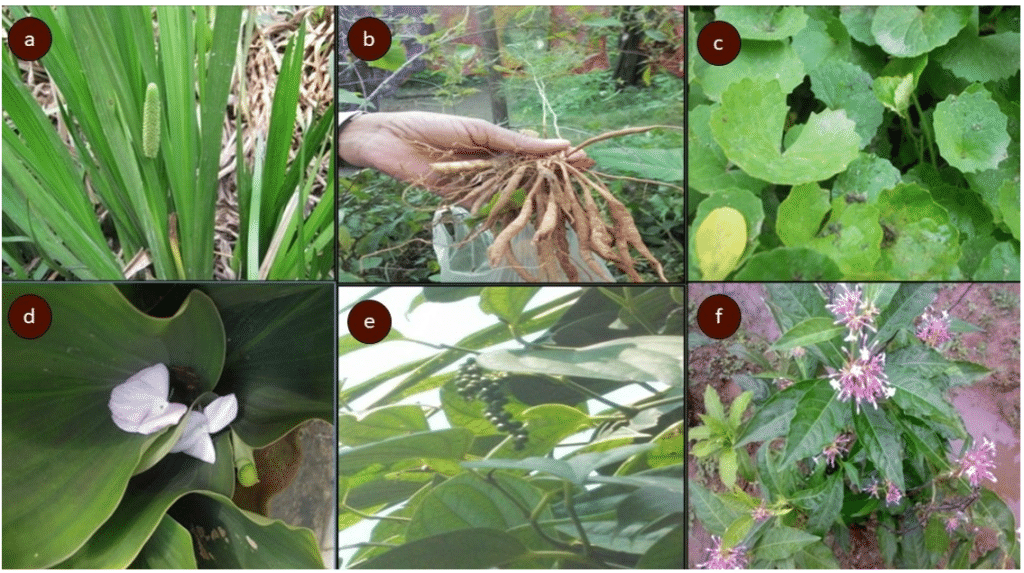
Figure 1: Photographic documentation of medicinal plant species used in traditional bone-fracture management in Murshidabad, West Bengal, India
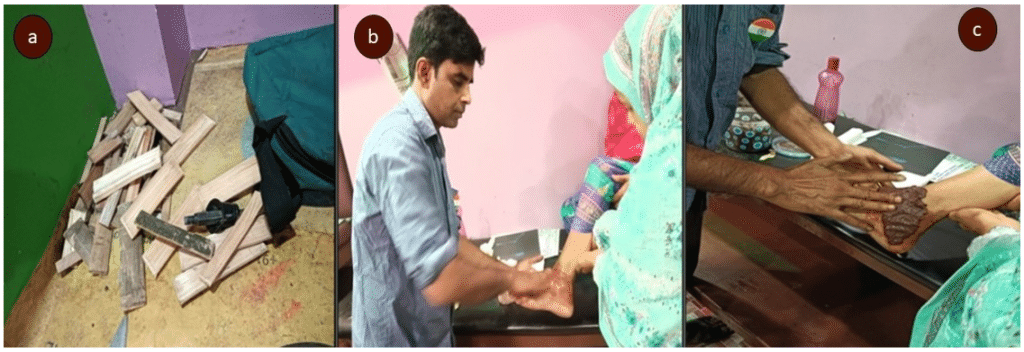
Figure 2: Traditional bone-fracture management practices by indigenous herbal healers, showing splinting materials and manual treatment procedures in Murshidabad, West Bengal, India
Conclusions
Many other ethno-botanical studies have showed that documenting indigenous knowledge through ethnobotanical investigations & studies is quite important for the conservation of biological and cultural diversities as well as sustainable utilization of bio-resources (Borthakur, 1994) Each and every tribe/ indigenous community has its own system of medicine, generally prepared from their ambient bio-resources. Gathering of this fact, on a global or even national basis will show more facets of these bio-resources than the Taxonomists will show (Jain, 1997). This paper is an effort to explore the hidden skills of such indigenous herbal healers, which may broaden the scope for comparisons between their treatments to the highly evolved and accepted modern treatment. And genuine efforts must also be implemented in order to recognize their IPR (Intellectual Property Rights), to sustainably utilize their precious knowledge and conserve this for our future generation.
References
Abd Jalil, M. A., Shuid, A. N., & Muhammad, N. (2012). Role of medicinal plants and natural products on osteoporotic fracture healing. Evidence-Based Complementary and Alternative Medicine. 2012: 714512. https://doi.org/10.1155/2012/714512
Al-Ajalein, A. A., Ibrahim, N. I., Fauzi, M. B., Mokhtar, S. A., Naina Mohamed, I., Shuid, A. N., & Mohamed, N. (2024). Evaluating the anti-osteoporotic potential of Mediterranean medicinal plants: A review of current evidence. Pharmaceuticals. 17(10): 1341. https://doi.org/10.3390/ph17101341
Alexiades, M. N. (1996). Selected guidelines for ethnobotanical research: A field manual. The New York Botanical Garden.
Bhishagratna, K. K. L. (2006). The Sushruta Samhita: An English translation based on original Sanskrit texts. Cosmo Publications.
Borthakur, S. K., & Gogoi, P. (1994). Conservation of biological diversity: A cultural tradition of the Tais. The Tai. 1: 189–199.
Cotton, C. M. (1996). Ethnobotany: Principles and applications. John Wiley & Sons.
Ghosh, A. (2003). Herbal folk remedies of Bankura and Medinipur districts, West Bengal (India). Indian Journal of Traditional Knowledge. 2(4): 393–396.
Giannoudis, P., Tzioupis, C., Almalki, T., & Buckley, R. (2007). Fracture healing in osteoporotic fractures: Is it really different? A basic science perspective. Injury. 38(Suppl. 1): S90–S99. https://doi.org/10.1016/j.injury.2007.02.014
Gullberg, B., Johnell, O., & Kanis, J. A. (1997). World-wide projections for hip fracture. Osteoporosis International. 7(5): 407–413. https://doi.org/10.1007/s001980050029
Haines, H. H. (1921–1925). The botany of Bihar and Orissa: An account of all the known indigenous plants of the province and of the most important or most commonly cultivated exotic ones (Parts I–VI). Adlard & Son & West Newman, Ltd.
Harwood, P. J., Newman, J. B., & Michael, A. L. R. (2010). An update on fracture healing and non-union. Orthopaedics and Trauma. 24(1): 9–23. https://doi.org/10.1016/j.mporth.2009.12.004
Jahagirdar, R., & Scammell, B. E. (2009). Principles of fracture healing and disorders of bone union. Surgery (Oxford). 27(2): 63–69. https://doi.org/10.1016/j.mpsur.2008.12.011
Jain, S. K. (1991). A manual of ethnobotany. Scientific Publishers. Jodhpur, 1991.
Jain, S. K. (1997). Cultural dimensions of biodiversity. Proceedings of the Indian National Science Academy Part B: Biological Sciences. 63(6): 449–466.
Jha, R.K., et. Al. (2022). A qualitative study of traditional bone setters in south India: A Case series. Kansaas Journal of Medicine. 15: 419-426. https://doi.org/10/10.17161/kjm.vol 15.18580
Kumar, Sanjeev 2014. Ethnobotanical Studies in India. Deep Publication, New Delhi.
Li, X., Quigg, R. J., Zhou, J., Ryaby, J. T., & Wang, H. (2005). Early signals for fracture healing. Journal of Cellular Biochemistry. 95(1): 189–205. https://doi.org/10.1002/jcb.20424.
Martin, G. J. (2004). Ethnobotany: A methods manual. Earthscan.
Murthy KRS. (2004) Shushruta Samhita. Chaukhamba Orientalia pp. 559-62.
Piermattei, D. L., Flo, G. L., & DeCamp, C. E. (2006). Handbook of small animal orthopedics and fracture repair (4th ed.). Saunders Elsevier.
Prain, D. (1903). Bengal plants: A list of the phanerogams, ferns and fern-allies indigenous to or commonly cultivated in the Lower Provinces and Chittagong, with definitions of the natural orders and genera, and keys to the genera and species (Vols. 1–2). West, Newman & Co.
Rao, R. R. (1996). Traditional knowledge and sustainable development: Key role of ethnobiologists. Ethnobotany. 8: 14–24.
Singh, V. (2017). Medicinal plants and bone healing. National Journal of Maxillofacial Surgery. 8(1): 4–11. https://doi.org/10.4103/0975-5950.208972

Dedicated to advancing biodiversity conservation and the sustainable management of natural resources for current and future generations.
Copyright © 2026 Journal of Biodiversity And Conservation || Designed By Antler’s Solution