
Journal of Biodiversity and Conservation 10(4): 21 – 25
2026
ISSN: 2457-0761 (online)
Ram Kumar Rajwade, Motilal Patel & Devendra Kumar Patel*
Department of Botany, Guru Ghasidas Vishwavidyalaya (A Central University), Bilaspur, Chhattisgarh, India
*Email-ID: dplantscience@yahoo.co.in; ORCID: https://orcid.org/0000-0002-3562-1590
DOI: https://doi.org/10.5281/zenodo.23412227
Article Details: Received: 2026-10-01 | Accepted: 2026-10-09 | Available online: 2026-10-16
Licensed under a Creative Commons Attribution 4.0 International License
Abstract: Extensive field surveys conducted from August 2025 to September 2026 in Bilaspur District, Chhattisgarh, Central India, resulted in the documentation of Cleome gynandra L. (Cleomaceae), representing a new addition to the district flora of Bilaspur. The species was recorded from Koni, Bilaspur Tehsil, located approximately 5 km from Bilaspur city at 21.977978° N and 82.22908° E. The identification was confirmed through the examination of fresh plant specimens and relevant taxonomic literature. A brief taxonomic description, details of the collection locality, phenological observations, geographical distribution, and photographic documentation of the species are provided to facilitate its identification. This record contributes to the floristic knowledge of Bilaspur District and highlights the importance of systematic field surveys in documenting plant diversity and updating regional floristic inventories in Chhattisgarh, India.
Keywords: Floristic exploration, Phytogeography, Taxonomic documentation
Introduction
Cleome L., an annual herbaceous plant group, belongs to the family Cleomaceae. The genus comprises about 203 accepted species (POWO, 2026) with high morphological diversity, and the native range of this genus is the tropics and subtropics. It is used as animal food and medicine, etc. Cleome L. is represented by about approximately 15 species in India (e-flora of India, 2026) of which about seven species occur in Central India (Verma et al., 1985; Verma et al., 1993; Shukla et al., 2025; Pandey et al., 2023). Central India has comparatively fewer records: earlier accounts reported about seven species (Shukla et al., 2025; Verma et al., 1985). Previously, a total of three species were reported in the district flora of Bilaspur (Panigrahi & Murti, 1989). A recent Study reported a Cleome gynandra L. species with an extended distribution in the area of Bilaspur district, Chhattisgarh, revealing inconsistencies among existing inventories and underscoring incomplete floristic knowledge for Chhattisgarh, Central India, thereby highlighting the urgent need for intensified field surveys and systematic taxonomic revision.
Material and methods
Koni is situated in Bilaspur Tehsil of Bilaspur district, Chhattisgarh. It lies between 21.9779780N to 82.229080 E. It is located approximately 5 km from the tehsil headquarter. and 6 km from the district headquarters in Bilaspur, Chhattisgarh. During the extensive field surveys conducted from August 2025 to September 2026 in Bilaspur and its adjoining areas, including Koni of Bilaspur, Chhattisgarh, India, an interesting plant species of the genus Cleome L., C. gynandra L. (Cleomaceae) was collected. Representative specimens were collected, processed, and mounted on herbarium sheets. Microphotographs were obtained using a digital DSLR camera (Canon 700D). Specimens were identified by comparison with diagnostic descriptions and keys in primary floras and monographs and by consulting regional treatments and recent taxonomic accounts. (Panigrahi & Verma et al., 1985; Verma et al., 1993; Shukla et al., 2025). Nomenclature followed is as per POWO (2026). The voucher specimen was deposited at the herbarium of the Department of Botany, Guru Ghasidas Vishwavidyalaya, Bilaspur, Chhattisgarh, India.
Results and discussions
The recently collected specimens from Koni, Bilaspur, were critically evaluated against diagnostic descriptions and regional treatments and were identified as Cleome gynandra L. Voucher material was prepared and cross‑checked with standard taxonomic references and online nomenclature resources. This constitutes the documented new addition to the flora of the Bilaspur District from Chhattisgarh, Central India, and represents a notable range extension for the taxon, thereby enriching the district flora of Chhattisgarh.
Taxonomic descriptions
Cleome gynandra L. Sp. Pl. 671.1753
Erect, viscidly hairy, 30-60 cm tall, annual herb. Leaves digitately 3-7-foliolate, 0.1-4.4×0.6-2cm; leaflets elliptic-obovate or elliptic-lanceolate, sessile. Racemes terminal. Flowers creamy white, 5.6×1.1cm diam. Sepals 4, 0.10×0.06cm, acute, green. Petals 4, creamy white, 1.3×0.8cm, ovate- oblong. Androgynophore 0.9-1.6 cm. Anthers 6, purplish green, hairy, filament 2.2×0.01 cm; anther lobes 0.07×0.02cm. Gynoecium: ovary 0.06×0.01 cm; stigma, 0.01×0.01 cm, glabrous; capsules 5-8 cm long, linear-cylindric, minutely beaked, viscidly pubescent; seeds blackish-brown, 0.03×0.03cm across (Plate 1-2).
Flowering & fruiting: July – November
Specimen examined: India, Chhattisgarh, Bilaspur, Koni (22.1362520 N, 82.1246980 E; 280 m AMSL): 18.9.2026; Devendra Kumar Patel, Motilal Patel and Ram Kumar Rajwade [RKCG‑001; (Herbarium unit of Botany Department, Guru Ghasidas Vishwavidayalaya, Bilaspur, India].
Distribution: Native to: Angola, Assam, Bangladesh, Benin, Borneo, Botswana, Burkina, Burundi, Cambodia, Cameroon, Cape Provinces, Cape Verde, Central African Republic, Chad, China North-Central, China South-Central, China Southeast, Christmas I., Cocos (Keeling) Is., Congo, Djibouti, DR Congo, East Himalaya, Egypt, Eritrea, Ethiopia, Free State, Gabon, Ghana, Guinea, Guinea-Bissau, Gulf of Guinea Is., Gulf States, India, Ivory Coast, Jawa, Kenya, KwaZulu-Natal, Laos, Lesser Sunda Is., Libya, Madagascar, Malawi, Malaya, Maldives, Mali, Maluku, Mauritania, Mozambique, Myanmar, Namibia, Nepal, New Guinea, Niger, Nigeria, Northern Provinces, Northern Territory, Oman, Pakistan, Palestine, Philippines, Rwanda, Saudi Arabia, Senegal, Sierra Leone, Socotra, Somalia, South China Sea, Sri Lanka, Sudan-South Sudan, Sulawesi, Sumatera, Tanzania, Thailand, Togo, Uganda, Vietnam, Western Australia, Yemen, Zambia and Zimbabwe. Introduced into: Alabama, Andaman Is., Aruba, Bahamas, Bermuda, Brazil Northeast, Brazil Southeast, Caroline Is., Colombia, Comoros, Cuba, Dominican Republic, Fiji, Florida, French Guiana, Georgia, Hainan, Haiti, Hawaii, Jamaica, Kazan-retto, Leeward Is., Louisiana, Marquesas, Mauritius, Mexico Gulf, Mexico Northeast, Mexico Northwest, Mexico Southeast, Mexico Southwest, Mississippi, Netherlands Antilles, New Caledonia, New York, Nicaragua, Nicobar Is., North Carolina, Oklahoma, Pennsylvania, Peru, Puerto Rico, Queensland, Rodrigues, Réunion, Seychelles, Society Is., South Carolina, Spain, Suriname, Taiwan, Texas, Trinidad-Tobago, Turks-Caicos Is., Venezuela, Venezuelan Antilles and Windward Islands.
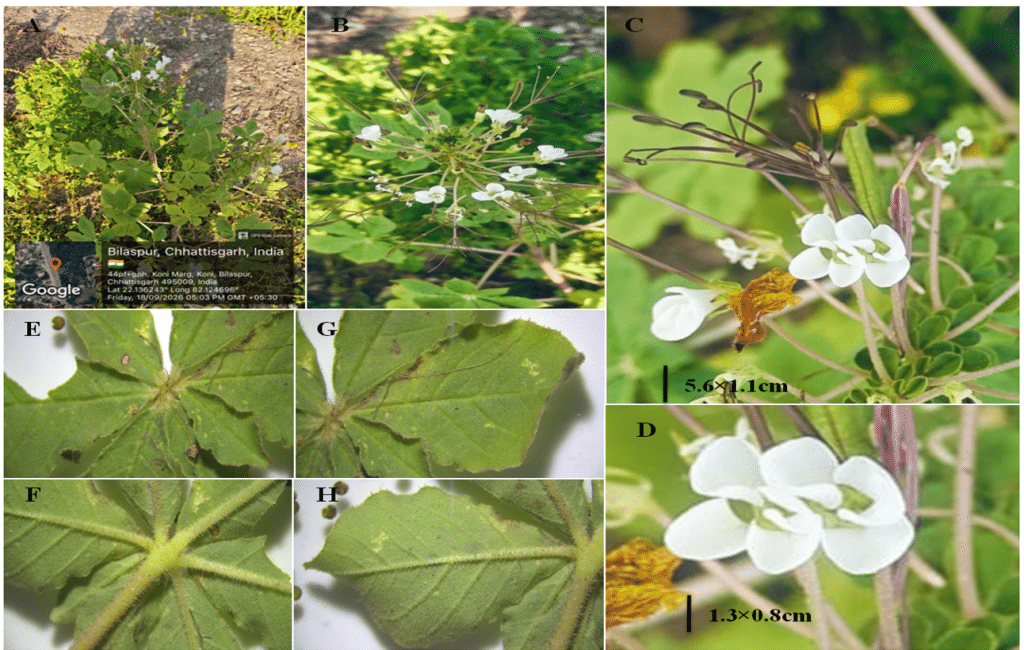
Plate 1: Cleome gynandra L.: (A) Habit, (B–C) Inflorescence, (D) Close-up view of flowers, (E–H) Adaxial and abaxial surfaces of the leaf
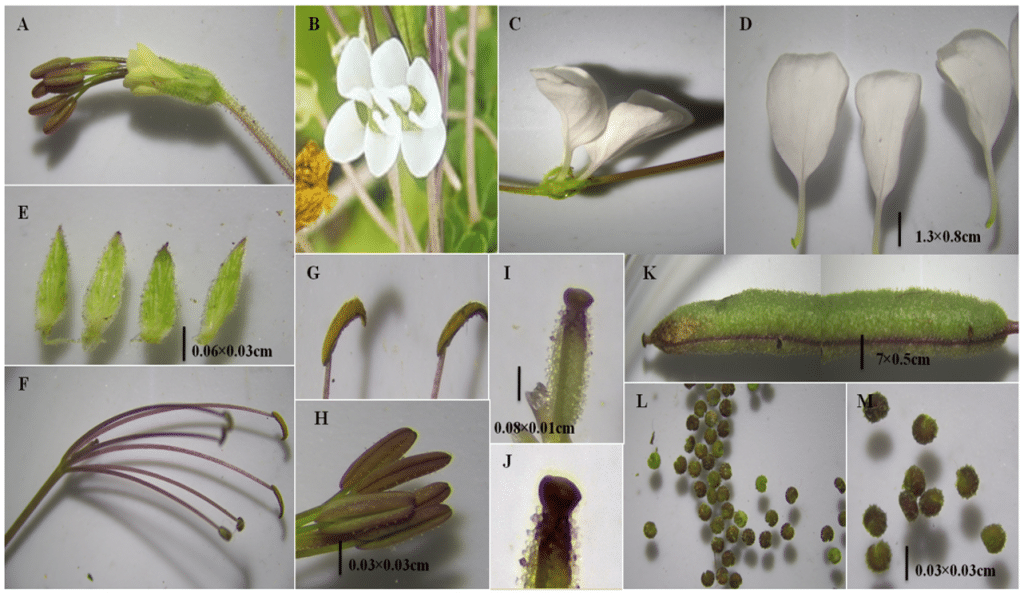
Plate 2: Cleome gynandra L.: (A) Floral bud, (B–C) Flower (front and lateral views), (D) Petals, (E) Sepals, (F) Stamens, (G–H) Anthers, (I–J) Stigma (detailed views), (K) Mature fruit, (L–M) Seeds
Conclusions
The principal threats are anthropogenic factors, particularly habitat loss from deforestation, unchecked human activity, and frequent forest fires, which are the main dangers to the plants of Bilaspur. In the Bilaspur District, these pressures put several native taxa at immediate risk of decline. Therefore, immediate conservation action is necessary, including community-based awareness and stewardship initiatives, fire management and restoration strategies, protection of important habitat patches, and focused population monitoring.
Acknowledgements
We sincerely thank the authorities and the Department of Botany, FIST, Guru Ghasidas Vishwavidyalaya (A Central University), Bilaspur, Chhattisgarh, for providing the necessary facilities needed for the present study. We are also thankful to the officials of the Forest Department of Bilaspur, Chhattisgarh, India, for their invaluable support during the field survey.
References
Kumar A and Rao PSN. (2003). Flora of the Indravati Tiger Reserve. Flora of the Indravati Tiger Reserve. Botanical Survey of India, Kolkata. 44.
Panigrahi G and Murti SK. (1989). Flora of Bilaspur District, Madhya Pradesh. Vol. I, Botanical Survey of India, Kolkata.107-110.
POWO 2026. Plants of the World Online. Facilitated by the Royal Botanic Gardens, Kew. https://powo.science.kew.org/.
Shukla AN, Tiwari AP and Mao AA. (2025). Flora of Chhattisgarh, Vol. I, Botanical Survey of India, Kolkata.86-88.
Pandey AK, Naik ML and Mishra RP. (2023). Biodiversity of Chhattisgarh: A checklist (1st ed.). Chhattisgarh State Biodiversity Board, Aranya Bhawan, Raipur. 121-126.
Verma DM, Pant PC and Hanfi MI. (1985). Flora of Raipur, Durg, and Rajnandgaon. Botanical Survey of India, Kolkata.30-31.
Naik ML, Mishra RP, Tiwari AP, Pandey AK and Mishra P. (2024). Biodiversity of Kanger Valley National Park, Vol. I, Chhattisgarh State Biodiversity Board, Aranya Bhawan, Raipur. 24.

Dedicated to advancing biodiversity conservation and the sustainable management of natural resources for current and future generations.
Copyright © 2026 Journal of Biodiversity And Conservation || Designed By Antler’s Solution