
Journal of Biodiversity and Conservation 10(4): 11 – 20
2026
ISSN: 2457-0761 (online)
Sunil Pathak1, Babita Suman2, Tekameren Walling3 and Subhalakshmi Rout4*
1Department of Botany, Government College Barsar, Hamirpur, Himachal Pradesh, India
2Department of Botany, NSCBM Government College, Hamirpur, Himachal Pradesh, India
3Department of Botany, Sao Chang College, Tuensang (Affiliated to Nagaland University), Nagaland, India
4Department of Life Sciences, Rama Devi Women’s University, Bhubaneswar, Odisha, India
*Email ID: subhalakshmirout98@gmail.com; ORCID: https://orcid.org/0009-0000-2063-9547
DOI: https://doi.org/10.5281/zenodo.23257116
Article Details: Received: 2026-09-01 | Accepted: 2026-10-02 | Available online: 2026-10-09
Licensed under a Creative Commons Attribution 4.0 International License
Abstract: In today’s era, chronic diseases have surfaced due to unhealthy lifestyles and consumption of fast foods. This has raised interest in foods that provide benefits that go beyond just nutrition and hence, the concept of functional food is getting attention. Medicinal climbers in that aspect are a well-known source of food as well as medicine. Momordica charantia is a widely consumed medicinal climber with a record of traditional medicinal use, particularly for diabetes and metabolic disorders. In the given study, datasets from various sources have been analysed and compiled in thematic sections to review the potential of bitter gourd as a functional food and medicine. The review points out that its nutritional and therapeutic potential is attributed to diverse bioactive constituents, including cucurbitane triterpenoids, saponins, flavonoids, phenolics, polysaccharides, proteins and peptides. Among its reported activities, antidiabetic effects have received the strongest scientific attention, with experimental studies suggesting actions on carbohydrate digestion, glucose uptake, insulin secretion and signalling, hepatic glucose metabolism, oxidative stress and pancreatic β-cell protection. Preclinical studies also indicate antioxidant, anti-inflammatory, antimicrobial, hepatoprotective, anti-obesity and anticancer properties. However, evidence for these effects, particularly anticancer and antimicrobial activities, remains largely experimental. Clinical studies of glycaemic control show promising but inconsistent results, partly due to differences in dose, formulation, plant material, study duration and preparation standardisation. Safety considerations, including potential interactions with glucose-lowering drugs and concerns regarding concentrated preparations during pregnancy, also warrant attention. Although the current evidence does not support its use as a replacement for established medical treatment, it represents a promising functional food with therapeutic potential.
Keywords: Bitter gourd, functional food, metabolic health, nutraceutical, phytochemicals, unhealthy lifestyle
Introduction
Chronic diseases have recently intensified the interest in foods that provide benefits beyond basic nutrition (Zhang et al., 2025). This has given rise to the concept of ‘functional foods’ that are generally understood as foods containing physiologically active components capable of producing health benefits when consumed as part of the diet (Essa et al., 2023). As a part of example, we can consider medicinal climbing plants that are simultaneously consumed as fruits and vegetables and are of particular interest because they occupy an interface between nutrition and traditional medicine (Mukherjee and Kumar, 2023). Momordica charantia L., commonly known as bitter gourd or bitter melon (Figure 1), is one such medicinal climber (Singh et al., 2023). It belongs to the family Cucurbitaceae and is cultivated extensively across Asia, Africa and other tropical and subtropical regions in the world (Swamy, 2023). The immature fruit has a distinctive bitter taste and is commonly consumed as a vegetable (Singh et al., 2024). In South and Southeast Asian traditional systems of medicine, different parts of the plant have been used for a variety of conditions, including diabetes and digestive disorders (Sharma et al., 2024). The biological properties of M. charantia are attributed to a complex mixture of nutrients and secondary metabolites rather than to a single compound (Xue et al., 2025). Several of the reported compounds in this plant have demonstrated biological activities in experimental systems. Among the claimed therapeutic properties, glucose-lowering activity has received the most attention (Mkhize et al., 2025). Nevertheless, the translation of these findings into clinical practice remains incomplete. Earlier clinical studies were generally small, used different preparations and often had methodological limitations. More recent systematic reviews have produced somewhat divergent conclusions, emphasising the importance of standardised preparations and well-designed randomised controlled trials. Present study was therefore undertaken to compile the data available across online and offline scientific databases and books regarding M. charantia to examine it as both a functional food and a climbing plant of medicinal use. Available datasets are examined, analysed and organised in thematic sections for easier understanding, with original photographs. Particular attention has been given to aspects like nutritional and phytochemical composition, pharmacological activities, proposed mechanisms, clinical evidence, safety and future research priorities.
Botanical description
It is an annual, slender, herbaceous climbing vine, characterised by its distinctly bitter taste and odour. (Swamy, 2023). Stems are angular, branched and pubescent. Leaves are alternate, simple, palmate and deeply lobed with 3-9 lobes with a serrate margin. Flowers are bright yellow, five-petaled, radially symmetrical and monoecious. The plant produces characteristic elongated green coloured fruits with a highly warty or ridged surface which turns yellow to orange as it matures. When fully ripe, it splits into curling segments to expose flat, oblong seeds covered in bright red sticky pulp in parietal placentation (Sharma et al., 2024). Fruit morphology, size, bitterness and colour vary considerably among cultivars and geographical populations (Figure 1).
Ethnobotanical uses
The plant has been documented as an insecticide & fungicide, as it is used for soaking seeds in water before sowing and the herbaceous stems are used in water for bathing as a remedy for skin infections (Beloin et al., 2005). Leaves and young shoots of this plant are also consumed in some regions (Muronga et al., 2021), while seeds and other plant parts have been medicinally employed. Traditional medicinal uses of M. charantia include management of diabetes, gonorrhoea, chickenpox, malaria, measles, scabies, various gastrointestinal complaints, skin disorders, fever, parasitic infections and inflammatory conditions (Sardar and Kumar, 2023; Sharma et al., 2024). The immature fruit is the principal edible portion. Depending on culinary traditions, it is consumed fresh, cooked, dried, pickled, fried, juiced or incorporated into composite food products (Bara et al., 2025).
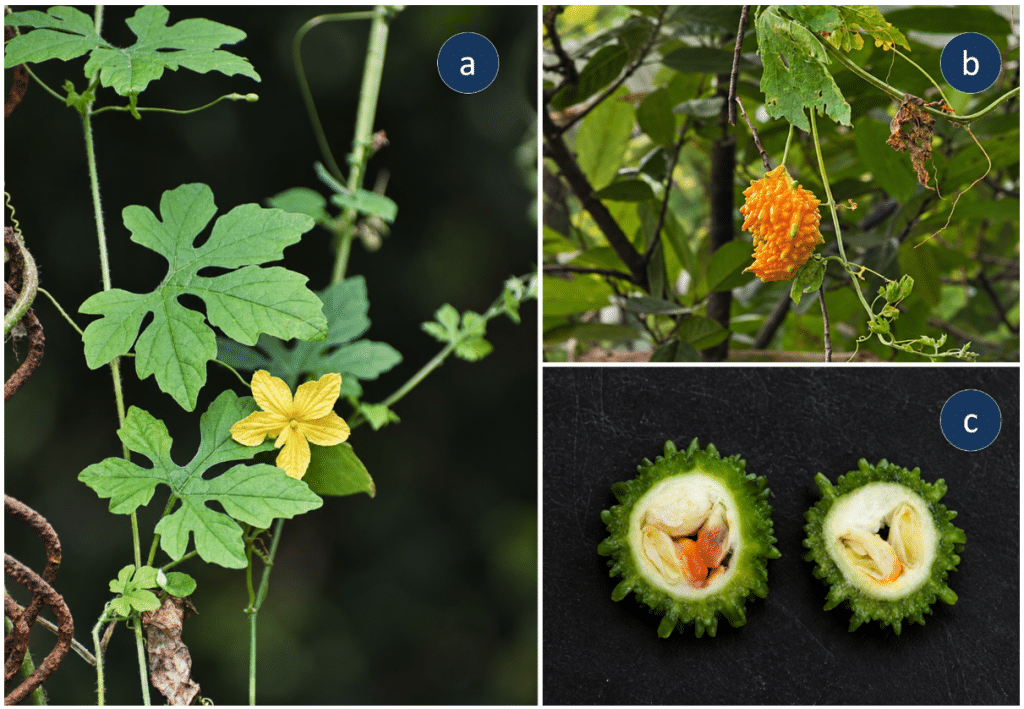
Figure 1: Plant parts of M. charantia, (a) vine with inflorescence, (b) mature fruit and (c) transverse section of the spiky fruit showing oblong seeds covered in red pulp
Nutritional importance
Bitter gourd provides dietary fibre, vitamins, minerals and various phytochemicals while generally contributing relatively little energy compared with many staple foods (Xue et al., 2025). The fruit contains vitamin C, antioxidants, together with minerals and phenolic compounds (Abbas et al., 2026). Importantly, nutritional composition varies according to cultivar, maturity, growing conditions, geographical origin, harvesting stage and processing. Consumption of bitter gourd as a vegetable exposes the consumer to a complex food matrix containing water, fibre, nutrients and phytochemicals (Malik et al., 2026).
Secondary metabolites
The pharmacological interest in M. charantia derives largely from its diverse primary and secondary phytochemical profile.
Cucurbitane-type triterpenoids: Cucurbitane-type triterpenoids are among the characteristic secondary metabolites of M. charantia. Compounds, including momordicosides, charantosides, karavilosides, kuguasides and related triterpenoid derivatives, have been identified. Some of them are Charantin, Cucurbitacins, Kuguacins A-S, Momordicine (I, II & III), Momordicoside D, Karavilagenin A-E, Saponins, Goyasaponins and Sapogenins (Ma et al., 2010). These compounds have been investigated for glucose-lowering, anti-inflammatory, antioxidant and anticancer properties (Bara et al., 2025).
Steroidal saponins and glycosides: Steroidal saponins and glycosides are one of the majorly found phytoconstituents in bitter gourd. Charantin, a natural, non-nitrogenous steroidal glycoside found in fruits, is frequently discussed in relation to the plant’s antihyperglycemic properties (Desai and Tatke, 2015). Various momordicosides and related glycosides have also been isolated. Phytosterols include β-sitosterol, campesterol, stigmasterol, stearic acid, α-linoleic acid and α-eleostearic acid (Bara et al., 2025). The biological effects of these compounds may include modulation of carbohydrate metabolism and cellular signalling, although their individual contributions to clinical effects remain incompletely established.
Flavonoids and phenolic compounds: Flavonoids and phenolic compounds are important contributors to the antioxidant properties of food plants (Perumal et al., 2021). Compounds like catechin, epicatechin, kaenferol, rutin, vanillin, quercetin, luteolin, chlorogenic acid, p-coumaric acid, ferulic acid, caffeic acid, gallic acid, salicylic acid, syringic acid, ethyl gallate, naringenin, apigenin and pyrogallol (Bara et al., 2025) have been isolated and reported from M. charantia. These constituents may help neutralise reactive oxygen species (ROS) and influence inflammatory pathways (Kattah et al., 2026).
Proteins and bioactive peptides: Bitter gourd contains biologically active proteins and peptides. Some have demonstrated insulin-like, antiviral, immunomodulatory or cytotoxic effects in experimental studies (Han et al., 2024). One extensively investigated peptide is the M. charantia insulin receptor-binding peptide, mcIRBP-19. A randomised clinical study of an extract containing this peptide reported a possible glucose-lowering effect (Hsu et al., 2020), although the overall sample was small and the principal analysis produced only borderline statistical significance for fasting glucose and HbA1c.
Polysaccharides: Recent reviews describe M. charantia polysaccharides as heterogeneous macromolecules with pharmacological activities. They are basically acidic or neutral branched heteropolysaccharides made up of basic monomers like Glucose (Glu), Galactose (Gal), Arabinose (Ara), Xylose (Xyl), Rhamnose (Rha), Mannose (Man) and Galacturonic acid (Zheng et al., 2024).
Pharmacological and therapeutic values
Antidiabetic activity of M. charantia is the most extensively studied medicinal property. Experimental studies suggest that bitter gourd may improve glucose homeostasis by inhibiting carbohydrate-digesting enzymes, enhancing glucose uptake and insulin secretion, improving insulin signalling, reducing hepatic gluconeogenesis, modulating lipid metabolism, lowering oxidative stress and protecting pancreatic β-cells (Table 1). Human studies have reported reductions in fasting glucose, HbA1c, fructosamine and other glycemic parameters, although results are inconsistent (Shih et al., 2009). Differences in dose, formulation, duration and study population contribute to this variability. Research shows that M. charantia possesses notable anticancer, antiproliferative and pro-apoptotic properties in preclinical laboratory and animal models (Li et al., 2012). Its bioactive compounds may inhibit cancer-cell proliferation and induce apoptosis through mechanisms involving caspases, mitochondrial dysfunction, cell-cycle arrest and pathways such as AKT/mTOR and MAPK (Zulfiqar et al., 2026). The plant also exhibits antimicrobial (Malwal, 2026), antiviral and antiparasitic activities in experimental models (Jia et al., 2017), potentially due to its proteins, peptides, saponins and other phytochemicals. Similarly, hepatoprotective and gastrointestinal effects have been reported (Wu et al., 2021; Dahlquist et al., 2023), including antioxidant, anti-inflammatory, gastroprotective and antiulcer activities.
Table 1: Overview of the proposed mechanisms contributing to the antidiabetic potential of M. charantia
Target/process | Proposed effect of M. charantia | Potential metabolic consequence(s) | Source(s) |
Inflammatory signalling | Modulation of NF-κB- and MAPK-associated pathways | Potential reduction in inflammatory responses and improvement in metabolic health | Dangi and Shrivastava, (2024) |
Insulin signalling | Modulation of insulin receptor/PI3K–Akt signaling | Potential improvement in insulin sensitivity and reduced insulin resistance | Sridhar et al., (2008) |
Intestinal carbohydrate digestion | Inhibition of α-glucosidase and related enzymes | Reduced postprandial glucose rise | Mkhize et al., (2025) |
Intestinal glucose absorption | Modulation or inhibition of glucose transport | Potential reduction in intestinal glucose absorption | Dahlquist et al., (2023) |
Lipid metabolism | Modulation of lipid synthesis and fatty-acid oxidation | Potential improvement in lipid metabolism and dyslipidemia | Bai et al., (2026) |
Liver | Suppression of hepatic of gluconeogenesis | Reduced hepatic glucose production | Wu et al., (2021) |
Oxidative stress | Antioxidant activity and modulation of cellular antioxidant defences | Protection of β-cells and metabolic tissues | Kavitha et al., (2011) |
Pancreatic β-cells | Stimulation of insulin and protection of β-cell functions | Increased Insulin availability and improved glucose regulation | Joseph and Jini, (2013) |
Skeletal muscle and adipose tissue | Enhancement of peripheral glucose uptake and utilisation | Improved glucose disposal and potential reduction in blood glucose | Shih et al., (2009); Bao et al., (2013) |
Bitter gourd as a functional food
The functional-food potential of M. charantia is attractive because the plant can be put into the diet rather than being used exclusively as a medicinal preparation (Figure 2). Potential food applications include: fresh or cooked vegetable, juice, dried fruit powder, pickles, herbal beverages, bakery products, fermented products, nutraceutical formulations and standardised extracts.

Figure 2: Culinary preparations of M. charantia, (a) fresh fruits, (b) thinly sliced circular pieces, (c) stir-fried bitter gourd and (d) bitter gourd juice
Recent research has specifically examined the use of bitter gourd and its bioactive compounds in food products and industrial applications (Mohammed et al., 2023). From a public-health perspective, incorporating bitter gourd into a diverse diet may be more appropriate than promoting highly concentrated preparations without adequate evidence on dosing and safety. Food synergy is also important. The biological effects of a whole vegetable may differ from those of isolated compounds because fibre, micronutrients, phytochemicals and the food matrix interact with digestion, absorption and metabolism.
Safety and limitations
Although M. charantia is widely consumed as a vegetable, concentrated extracts and high doses may pose safety concerns, particularly because of potential hypoglycemic effects and interactions with antidiabetic medications. Medicinal or concentrated preparations should also be used cautiously during pregnancy because of reported reproductive and maternal toxicity in experimental studies. Safety may vary according to the plant part, preparation, dose and duration of use. Current evidence is limited by small sample sizes, short study durations, lack of standardized preparations, variation in cultivars and extraction methods and the predominance of preclinical studies for many reported therapeutic effects. In addition, inconsistent findings among meta-analyses make the clinical efficacy of M. charantia difficult to establish.
Future aspects
Future research should therefore focus on chemically standardized preparations, dose-response relationships, large and long-term randomized controlled trials, pharmacokinetic and bioavailability studies, drug-interaction assessment and comprehensive long-term safety evaluation. Greater attention to gut microbiota, food-matrix effects, cultivar-specific phytochemistry and development of standardized functional foods may further clarify the nutritional and therapeutic potential of M. charantia.
Conclusion
M. charantia is more than a bitter vegetable. It is a promising bridge between traditional wisdom, everyday nutrition and modern science. Its rich phytochemical profile and particularly its potential to support glucose regulation make it an interesting functional food, while its antioxidant, anti-inflammatory, anticancer and other biological activities continue to inspire research. However, much of this promise still rests on experimental evidence and stronger clinical studies are needed before therapeutic claims can be firmly established. For now, bitter gourd is best appreciated as a nutritious addition to a balanced diet, with its medicinal potential viewed as promising rather than proven. Continued research, standardisation and careful safety evaluation may ultimately transform this humble bitter fruit into a therapeutic resource.
References
Abbas A, Tabassum I, Vohra S, Weiskirchen R, Shoukat A, Afzal MK, Ijaz A, Anees N, Chaudhary AA and Alhudhaibi AM. (2026). Momordica charantia L.: nutritional composition, advanced extraction methods, phytochemistry, molecular mechanisms and industrial applications. Antioxidants. 15(7): 839. https://doi.org/10.3390/antiox15070839
Bai J, Zhu Z, Pan B, Yang Z, Dai C, Huang S, Zhu Y, Zhao Y, Zhang N and Xiao X. (2026). Momordicine I Mediates Lipid‐Lowering Effects of Momordica Charantia L. Triterpenoid Saponins via TFEB‐Driven Lysosomal Biogenesis. Journal of Food Science. 91(2): e70923. https://doi.org/10.1111/1750-3841.70923
Bao B, Chen YG, Zhang L, Na Xu YL, Wang X, Liu J and Qu W. (2013). Momordica charantia (Bitter Melon) reduces obesity-associated macrophage and mast cell infiltration as well as inflammatory cytokine expression in adipose tissues. PloS one. 8(12): e84075. https://doi.org/10.1371/journal.pone.0084075
Bara LV, Budau R, Apahidean AI, Bara CM, Iancu CV, Jude ET, Cheregi GR, Timar AV, Bei MF, Osvat IM and Domocos D. (2025). Momordica charantia L.: Functional health benefits and uses in the food industry. Plants. 14(17): 2642. https://doi.org/10.3390/plants14172642
Beloin N, Gbeassor M, Akpagana K, Hudson J, de Soussa K, Koumaglo K and Arnason JT. (2005). Ethnomedicinal uses of Momordica charantia (Cucurbitaceae) in Togo and relation to its phytochemistry and biological activity. Journal of Ethnopharmacology. 96(2005): 49-55.
Dahlquist A, Jandali D, Nauman MC and Johnson JJ. (2023). Clinical application of Momordica charantia (Bitter Melon) for reducing blood sugar in type 2 diabetes mellitus. International Journal of Nutrition. 7(4): 8-26.
Dangi J and Shrivastava A. (2024). Anti-Inflammatory activity of Momordica Charantia. International Journal of Pharmaceutical Sciences. 2(6): 930-943.
Desai S and Tatke P. (2015). Charantin: an important lead compound from Momordica charantia for the treatment of diabetes. Journal of Pharmacognosy and Phytochemistry. 3(6): 163-166.
Essa MM, Bishir M, Bhat A, Chidambaram SB, Al-Balushi B, Hamdan H, Govindarajan N, Freidland RP and Qoronfleh MW. (2023). Functional foods and their impact on health. Journal of Food Science and Technology. 60(3): 820-834.
Han W, Xu Y, Qimuge S, Wang C and Su X. (2024). Peptide BG from bitter gourd (Momordica charantia) improves adjuvant‐induced arthritis by modulating the necroptosis/neutrophil extracellular traps/inflammation axis and the gut microbiota. Mediators of Inflammation. 2024(1): 1995952. https://doi.org/10.1155/mi/1995952
Hsu PK, Pan FF and Hsieh CS. (2020). McIRBP-19 of bitter melon peptide effectively regulates diabetes mellitus (DM) patients’ blood sugar levels. Nutrients. 12(5): 1252. https://doi.org/10.3390/nu12051252
Jia S, Shen M, Zhang F and Xie J. (2017). Recent advances in Momordica charantia: functional components and biological activities. International Journal of Molecular Sciences. 18(12): 2555. https://doi.org/10.3390/ijms18122555
Joseph B and Jini D. (2013). Antidiabetic effects of Momordica charantia (bitter melon) and its medicinal potency. Asian Pacific Journal of Tropical Disease. 3(2): 93-102.
Kattah HX, Oliveira EA, Alves BH, Couto DS, Bittencourt WJ and Peconick AP. (2026). Exploring the bioactive potential of Momordica charantia: antioxidant and enzymatic evidence with anticancer applications. South African Journal of Botany. 197: 369-375.
Kavitha CN, Babu SM and Rao MB. (2011). Influence of Momordica charantia on oxidative stress-induced perturbations in brain monoamines and plasma corticosterone in albino rats. Indian Journal of Pharmacology. 43(4): 424-428.
Li CJ, Tsang SF, Tsai CH, Tsai HY, Chyuan JH and Hsu HY. (2012). Momordica charantia extract induces apoptosis in human cancer cells through caspase‐and mitochondria‐dependent pathways. Evidence‐Based Complementary and Alternative Medicine. 2012(1): 261971. https://doi.org/10.1155/2012/261971
Ma J, Whittaker P, Keller AC, Mazzola EP, Pawar RS, White KD, Callahan JH, Kennelly EJ, Krynitsky AJ and Rader JI. (2010). Cucurbitane-type triterpenoids from Momordica charantia. Planta Medica. 76(15): 1758-1761.
Malik M, Khangwal I and Kumar S. (2026). Nutritional profiling of bitter gourd (Momordica charantia L.): influence of extraction solvents and integrated nutrient management practices. Journal of Basic and Applied Research International. 32(1): 140-146.
Malwal M. (2026). Edible Cucurbitaceae species as natural sources of antimicrobial compounds. Journal of Biodiversity and Conservation. 10(2): 230-240.
Mkhize SL, Phoswa WN, Ngubane S and Mokgalaboni K. (2025). Efficacy of Momordica charantia in glycaemic control and insulin resistance among patients with prediabetes and type 2 diabetes. A GRADE-adherent meta-analysis of randomised controlled trials. Metabolism Open. 28: 100407. https://doi.org/10.1016/j.metop.2025.100407
Mohammed FS, Uysal I and Sevindik M. (2023). Functional food Momordica charantia: biological activities. Prospects in Pharmaceutical Sciences. 21(3): 22-29.
Mukherjee S and Kumar S. (2023). Common medicinal cucurbits of India and prediction of their pharmacological potential. In: Dimri R, Sharma BP, Kumar A, Behera B and Kumar S (Eds.). (2023). Medico Biowealth of India, Volume 8. Ambika Prasad Research Foundation, Odisha, India.
Muronga M, Quispe C, Tshikhudo PP, Msagati TA, Mudau FN, Martorell M, Salehi B, Abdull Razis AF, Sunusi U, Kamal RM and Sharifi-Rad J. (2021). Three selected edible crops of the genus Momordica as potential sources of phytochemicals: biochemical, nutritional, and medicinal values. Frontiers in Pharmacology. 12: 625546. https://doi.org/10.3389/fphar.2021.625546
Perumal V, Khatib A, Ahmed QU, Uzir BF, Abas F, Murugesu S, Saiman MZ, Primaharinastiti R and El-Seedi H. (2021). Antioxidants profile of Momordica charantia fruit extract analyzed using LC-MS-QTOF-based metabolomics. Food Chemistry: Molecular Sciences. 2: 100012. https://doi.org/10.1016/j.fochms.2021.100012
Sardar B and Kumar S. (2023). Ethnoveterinary practices using cucurbit crops: a case study in Sundarban, West Bengal, India. Journal of Biodiversity and Conservation. 7(4): 37-42.
Sharma SK, Baliyan P and Alam A. (2024). Momordica charantia L.: unlocking its potential as a nutritional food through ethnomedicinal and pharmacological properties. Research Journal of Botany. 19(1): 31-40.
Shih CC, Lin CH, Lin WL and Wu JB. (2009). Momordica charantia extract on insulin resistance and the skeletal muscle GLUT4 protein in fructose-fed rats. Journal of Ethnopharmacology. 123(1): 82-90.
Singh B, Chauhan J, Sardar B, Sharma BP, Devi RS, Kumar S and Lal S. (2024). Common medicinally important cucurbits of India. In: Singh RK and Kumar S (Eds.). (2024). Medico Biowealth of India, Volume 18. Ambika Prasad Research Foundation, Odisha, India.
Singh P, Pandey P, Singh PK, Tripathi M, Singh RP, Shukla S, Pathak N and Singh RL. (2023). A comprehensive review on phytochemistry, nutritional and pharmacological properties of Momordica charantia. IP International Journal of Comprehensive and Advanced Pharmacology. 8(2): 73-79.
Sridhar MG, Vinayagamoorthi R, Suyambunathan VA, Bobby Z and Selvaraj N. (2008). Bitter gourd (Momordica charantia) improves insulin sensitivity by increasing skeletal muscle insulin-stimulated IRS-1 tyrosine phosphorylation in high-fat-fed rats. British Journal of Nutrition. 99(4): 806-812.
Swamy KRM. (2023). Origin, distribution, taxonomy, botanical description, cytogenetics, genetic diversity and breeding of bitter gourd (Momordica charantia L.). International Journal of Development Research. 13(01): 61294-61306.
Wu S, Huang C, Chen YR, Huang HC, Huang WC and Lai YH. (2021). Momordica charantia leaf extract reduces hepatic lipid accumulation and diet-induced dyslipidemia in zebrafish through lipogenesis and beta-oxidation. Journal of Functional Foods. 87: 104857. https://doi.org/10.1016/j.jff.2021.104857
Xue S, Sajjad M, Zhou M, Xu Y, Luo W, Lin Y, Jin Q, Zheng X and Zhong YJ. (2025). Multi-omics study uncovered key differences in taste and nutritional quality among three distinct bitter gourd (Momordica charantia L.) cultivars. Food Chemistry: Molecular Sciences. 11: 100308. https://doi.org/10.1016/j.fochms.2025.100308.
Zhang X, Zeng Q and He W. (2025). From broad-spectrum health to targeted prevention: a review of functional foods in chronic disease management. Molecules. 31(1): 103. https://doi.org/10.3390/molecules31010103
Zheng J, Shang M, Dai G, Dong J, Wang Y and Duan B. (2024). Bioactive polysaccharides from Momordica charantia as functional ingredients: a review of their extraction, bioactivities, structural-activity relationships and application prospects. Critical Reviews in Food Science and Nutrition. 64(32): 12103-12126.
Zulfiqar H, Tasnim J, Khalid N, Khan MU, Al-Shaalan NH, Alharthi S, Amin MA and Hossain KR. (2026). Mapping the anti-cancer mechanistic landscape of Momordica charantia using network pharmacology, molecular docking, MD simulation, and DFT analysis. Journal of Herbal Medicine. 59: 101128. https://doi.org/10.1016/j.hermed.2026.101128

Dedicated to advancing biodiversity conservation and the sustainable management of natural resources for current and future generations.
Copyright © 2026 Journal of Biodiversity And Conservation || Designed By Antler’s Solution