
Journal of Biodiversity and Conservation 10(3): 90-96
2026
ISSN: 2457-0761 (online)
Aarti1, Kavita1, Ranjeet Singh2, Ravi Kumar3, Jyoti Chauhan4 and Balkar Singh5*
1Botany Department, Kurukshetra University, Kurukshetra, Haryana, India
2Botany Department, Pt. CLS Govt. College Karnal, Haryana, India
3Botany Department, SD (PG) College, Panipat, Haryana, India
4Botany Department, Institute of Integrated and Honors Studies, Kurukshetra University, Kurukshetra, Haryana, India
5Botany Department, Arya PG College Panipat, Haryana, India
*Email ID: balkararya@gmail.com; ORCID: https://orcid.org/0000-0002-3730-7538
DOI: https://doi.org/10.5281/zenodo.22014136
Article Details: Received: 2026-07-24 | Accepted: 2026-08-13 | Available online: 2026-08-20
Licensed under a Creative Commons Attribution 4.0 International License
Abstract: A new record Oenothera laciniata Hill of the family Onagraceae Juss. was recorded during the recent floristic survey in Haryana, India. The species was collected from the semi-arid habitat of Pataudi tehsil, District Gurugram, Haryana and specimen was deposited in the herbarium of Wildlife Institute of India (WII), Dehradun. The species exhibits distinct morphological features, differentiating from its closely related taxa particularly O. rosea Aiton., and O. affinis Cambess. The plants formed rosette with pinnatifid leaves and set seed in early summer. O. laciniata had previously been documented as an addition to the flora of Rajasthan and the northwest plains (Delhi). The record from the Haryana extends known range of exotic taxon in northwest India and enhances more comprehensive assessments of the state’s plant diversity. The detailed description, photographs and location map of the species has been given for identification and further exploration.
Keywords: Additions, Cutleaf evening primrose, Naturalized species, Plant diversity
Introduction
Haryana is situated in Indo Gangetic plains of Northern region of India. This small state is characterized by semiarid to sub humid climate, fertile agricultural land and rich floral diversity. The whole state of Haryana is divided in 3 different agro-ecological zones exhibiting its ecological diversity (Bansal et al., 2025). Geographically the state of Haryana lies between 74.27 and 77.36E longitude and 27.39 and 30.55N latitude. The total area of state is approx. 44,212 sq km (Jain et al., 2000; Kumar, 2001 Balkrishna, 2018). The Gurugram district lies in southern part of Haryana and characterized by fine to coarse grained sandy type of soil, hot semi-arid climate and the elevation of Gurugram district varies from 225 to 275 meter above mean sea level (MSL) in plains and the hill range between 275 to 226 meter above MSL and annual rain fall is approx. 596 mm (Malik et al., 2010). Despite of xeric environment and less rainfall the Gurugram and nearby district have good number of floristic elements. During the field survey in southern part of Haryana a new species of family Onagraceae was reported. The Onagraceae family, also known as “Willow herb or Evening Primrose family” and is distinguished by Oenothera type of embryo sac. This family is represented by 18 genera and around 650 species worldwide and in India 46 species belongings to 4 genera. It is a small family represented by only few species in Haryana with 3 genera and 7 species (Jain et al., 2000; Kumar; 2001 Balkrishan, 2018; Malik et al., 2010; Sharma et al., 2021). On critical examination the reported specimen was recognized as genus Oenothera and finally identified as Oenothera lacinata Hill. The species under consideration here was collected from Pataudi region of Gurugram district of Haryana. A brief description of the species along with relevant information is presented here in this paper.
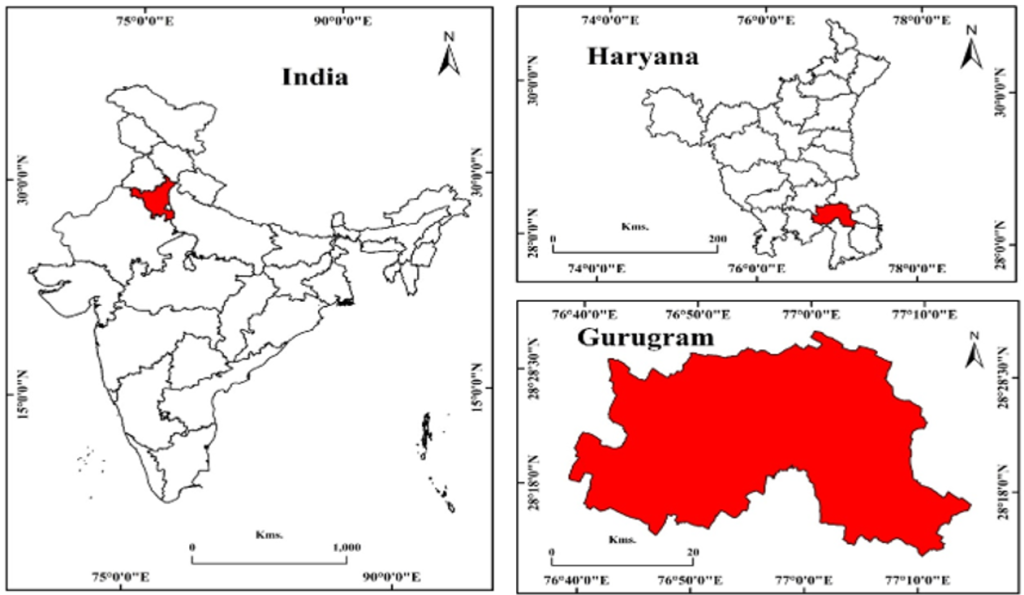
Figure 1: Map showing the distribution of O. laciniata from Januala, Gurugram region, Haryana, India
Materials and Methods
The plant under consideration was found in the village Janaula, tehsil Pataudi of district Gurugram. The location coordinates of the area extend from latitude 28.356043N, longitude 76.810378E and altitude is 233 meter as shown in the Figure 1. Plant specimen was collected in flowering stage and its characters were recorded like plant habit, habitat & morphology. The preliminary identification was made by comparing the specimen with the online databases such as Plants of the world Online (POWO), eFlora of India, World Flora Online, and International Plant Name Index (IPNI). Identification of the collected specimen was carefully confirmed with the help of taxonomic keys, relevant published literature and comparing with online herbarium specimen (POWO). Thorough study of the existing literature on flora of Haryana (Jain et al., 2000; Kumar; 2001 Balkrishan, 2018; Sharma et al., 2021; et al., 2025; Verma et al., 2025; Naithani and Chandra, 2022, Singh and Singh, 2014; Kavita et al., 2026) revealed that this species has not been reported from Haryana in any of the earlier reports. The voucher specimen was prepared by using conventional herbarium techniques (Davies et al., 2023). It has subsequently been deposited in the herbarium of Wildlife Institute of India (WII) and accession number was assigned WII013397 as shown in Figure 3.
Distribution
Oenothera laciniata Hill. is native to eastern part of North America and also distributed in South America, South Africa, Europe, Korea, Japan, China (Amini and Zare, 2003). In India, its occurrence has been recorded in different regions such as north western plains (Uttar Pradesh (Khan et al., 1984); Southern India (Tamil Nadu, Kerala (Sasidharan, 2004); Punjab and Delhi (Kaur et al., 2018) and Rajasthan (Gena et al., 2018). From Haryana this species was frequently observed in different parts of Pataudi tehsil of Gurugram district along with other crops like Wheat, Brassica and many other floriculture crops.
Results
Taxonomic treatment of Oenothera laciniata Hill
Oenothera laciniata Hill, Syst. Veg., 12 (App): 64, t.10.1767 (Hort. Kew.172 940, t.6. 1768); Nayar et al. 2011; Munir et al. 2017; Mahklouf, 2016; Gena et al. 2018; Kaur et al. 2018; Fl. Peninsular. 2019.
Synonyms: Oenothera sinuata L. Mant.Pl.2:228. (1771). Raimannia laciniata (Hill) Rose ex Britton & A. Brown.
English name: Cutleaf evening primrose
Annual, prostrate and procumbent herb found in open, grassland, semiarid region. Leaves simple, alternate, pinnately hairy rosette, basal leaves petiolate and forming a rosette, cauline leaves sessile to shortly petiolate and narrowly lanceolate to elliptic (2–10 × 0.5–3.5 cm), margin are deeply lobed to dentate, apex acute, rounded lobes, or sometimes merely wavy-edged or toothed. Stem simple, branched, and hairy. Inflorescence terminal, lax, open leafy spike. Flower ebracteate, sessile, tetramerous, with 4 yellow heart shaped petals up to 1cm long that become pinkish orange after pollination. Calyx 4 and green. Stamens 8, linear, exserted and lobes are pale yellow. Gynoecium tetra-carpellary, syncarpous, and ovary inferior; Fruit cylindrical capsule and up to 4 cm long. Seeds dark brown and arranged in two rows per locule. All morphological characters are represented in photograph as shown in Figure 2 (Nayer et al., 2012; Gena et al., 2018)
Fl & Fr: March to September
Specimen examined
India, Haryana, Pataudi tehsil, Gurgram district, 28.356043N and 76.810378E. Aarti, WII013397, 04-04-2026.
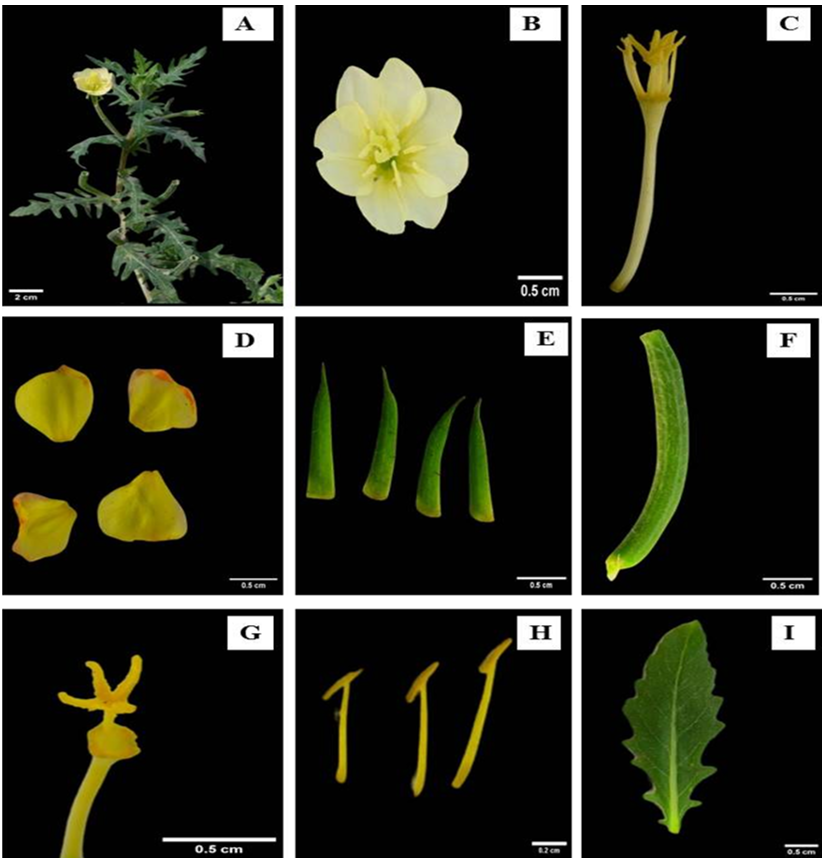
Figure 2: Plant parts of O. laciniata Hill (A) Whole plant, (B) Flower, (C) Monoecious condition, (D) Petal, (E) Sepal, (F) Fruit, (G) Lobed stigma, (H) Stamen and (I) Leaf
Ecology
The specimen was collected from cultivated fields and coexisting with some other rosette forming species such as Tribulus terrestris L., Lepidium didymum L., Chenopodiastrum murale (L.) S.Fuentes, Uotila & Borsch and Chenopodium album L. Frequently occurrence of this species was observed in fields cultivated with ornamental crops indicating its potential to establish as a weed in the future.
Taxonomic key of the species found in Haryana
1a. Flower yellow, capsule cylindrical ………………………………………………..…..2
1b. Flower pink; leave ovate to lanceolate, glabrous; hypanthium 0.4- 0.8 cm……….. ……………………………………………………………………Oenothera rosea Aiton
2a. Leaves deeply pinnatifid, oblanceolate to eliiptic, pubescent; hypanthium 1.5 to 3.5 cm; capsule cylindrical……………………………………………….. Oenothera laciniata Hill
2b. Leaves linear lanceolate and entire to undulate; hypanthium 8 to 12 cm ……… ……… …………………………………………………………………Oenothera affinis Cambess.
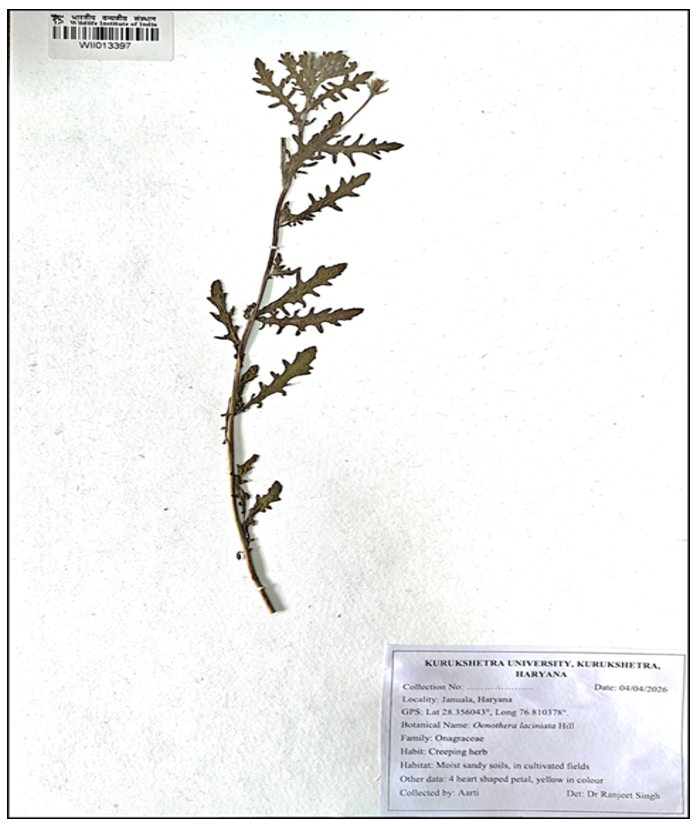
Figure 3: Voucher specimen of O. laciniata Hill
Discussion
The species has established itself in cultivated fields and other disturbed environments in many parts of India. Its presence in Delhi, Punjab, Rajasthan and now in Haryana shows that it is spreading at a good pace, particularly in wheat and brassica fields (Nayer et al., 2018). It is an important alien species which may be invasive in nature. It is necessary to monitor its spread in India as it may be a potential crop contaminant in near future as suggested by another researcher also (Mahklouf, 2016). The frequent occurrence of O. laciniata in cultivated fields in Haryana suggests its establishment under the suitable ecological conditions of the area.
Acknowledgement
First authors sincerely acknowledge the University Grants Commission (UGC) for providing financial assistance and support during the course of this research work. The authors are highly grateful to Principal, Arya PG College, Panipat and Chairperson, Botany Department, Kurukshetra University, Kurukshetra for providing the necessary facilities required for the research. The authors also thank Dr. Amit Kumar, Herbarium In-charge, WII, Dehradun, for his assistance and allowing the herbarium facilities.
Conflict of Interest
The authors declare that they have no conflict of interests.
References
Figure 2 Pictorial representation of morphological features (A) Whole plant, (B) Flower, (C) Gynoecium, (D) Petals, (E) Sepals, (F) Fruit, (G) Crucifer stigma (H) Androecium, (I) Leaf.
|
Amini T and Zare H. (2003). Oenothera sinuata L. (Onagraceae), A New Record for The Flora of Iran. Iran. Journal of Botany. 10(1):41-3. https://dor.isc.ac/dor/20.1001.1.1029788.1382.10.1.7.0
Balkrishna A. (2018). Flora of Morni Hills. Research & Possibilities. Koeltz Botanical Books. pp 9-581
Bansal H, Pawar, N, Malik DP, Devi M and Singh A. (2025). Land and Water Resource Degradation in Agricultural Zones of Haryana: Drivers, Consequences, and Remedial Measures. Asian Journal of Agricultural Extension, Economics & Sociology. 43(6):220-230.
Davies NMJ, Drinkell C and Utteridge TMA. (2023). The Herbarium Handbook. Royal Botanic Garden, Kew. pp. 11-152.
Dhaliwal, DS and Sharma M. (1995). Oenothera affinis Camb. (Onagraceae)-a new record for India from Himalaya. Rheedea. 5(2):151-153.
eFloraofIndia. 2026 July 01 (Cited 2026 July 11) Available from: https://efloraofindia.com/efi/oenothera-laciniata/
Gena CB, Gena D and Meena SL. (2018). Oenothera laciniata Hill (Onagraceae): A New Record for the Flora of Rajasthan (India). Indian Journal of Forestry. 41(2):205-206. https://doi.org/10.54207/bsmps1000-2018-911BNG
International Plant Name Index. 2026 July 13 (Cited 2026 July 11) https://www.ipni.org/n/281538-2
Jain SP, Verma DM, Singh SC, Singh JS and Kumar S. (2000). Flora of Haryana. Central Institute of Medicinal and Aromatic Plants. Lucknow, Uttar Pradesh, India. pp 19-243.
Kaur S, Barua IC, Kaur T, Kaur N, Kaul A and Bhullar MS. (2018). Appearance of new weeds in Punjab. Indian Journal of Weed Science. 50(1):59-63. https://doi.org/10.5958/0974-8164.2018.00013.8
Kavita, Aarti, Chauhan J, Singh R, Kumar R and Singh B. (2026). Senecio vulgaris L. (Asteraceae): A New addition to the flora of Haryana state, India. Journal of. Biodiversity and Conservation. 10(2):94-98. https://doi.org/10.5281/zenodo.20391306
Khan AA, Hussain W and Khan AH. (1984) Oenothera sinuata Linn. A new record for India from Bijnor. Journal of Scientific Research. 6(2):99-100.
Kumar S. (2000). The Flora of Haryana. Bishen Singh Mahendra Pal Singh. Dehradun, India. pp 507
Mahklouf M. (2016). A new Record Oenothera laciniata Mill for the Flora of Libya. International Journal of Modern Botany. 6(1):6-9. https://doi.org/10.5923/j.ijmb.20160601.02
Malik VS, Singh RK and Singh S.K. (2010). Impact of urbaniazation on groundwater of Gurgaon district, Haryana, India, International Journal of Rural Development and Management Studies. 5(1):45-57.
Munir R, Semmar N, Farman M and Ahmad NS. (2017). An updated review on pharmacological activities and phytochemical constituents of evening primrose (genus Oenothera). Asian Pacific Journal of Tropical Biomedicine. 7(11):1046-1054. https://doi.org/10.1016/j.apjtb.2017.10.004
Naithani HB and Chandra A. (2022). Additions to the State flora of Haryana (India). Pleione. 16(1):97-102.
Nayar E, Pradheep K and Bhandari D. (2012). Oenothera laciniata Hill (Onagraceae): Addition to the Flora of North-western Plains. Indian Journal of Plant Genetic Resources. 25:195-6. Available at: https://indianjournals.com/article/ijpgr-25-2-016
Plant of the World Online. 2026 July 01 (Cited 2026 July 11) Available from: https://powo.science.kew.org/taxon/urn:lsid:ipni.org:names:613817-1
Sasidharan N. (2004). Biodiversity documentation for Kerala Part 6: Flowering plants. Kerala Forest Research Institute, Peechi, India.
Sharma Y, Singh N and Tomar K. (2021). Interesting and uncommon plant records from central and southern Haryana, India. In: International Conference on Scientific Developments in the Current Era ICSDCE; 2021 I.B. (PG) College, Panipat, Haryana, India. pp. 201-206.
Singh B and Singh J. (2014). Ethnobotanical uses of some plants from central Haryana, Phytodiversity. 1(1&2):7-2.
Singh J, Saini M and Mubashshir M. (2025). Phenological aspects and Ecological significance of Native Plants of Aravalli range adjoining district Gurugram, Haryana. Research Square. pp.1-12. https://doi.org/10.21203/rs.3.rs-7686952/v1
The World Flora Online. 2026 July 13 (Cited 2026 July 11) Available from: https://www.worldfloraonline.org/taxon/wfo-0000389445
Verma PK, Singh N, Negi R, Chandra A and Kishwan S. (2025). Forest Flora of Haryana: An Annotated Checklist. PhytoTalks. 2(2): 345-444. https://doi.org/10.21276/pt.2025.v2.i2.7

Dedicated to advancing biodiversity conservation and the sustainable management of natural resources for current and future generations.
Copyright © 2026 Journal of Biodiversity And Conservation || Designed By Antler’s Solution