
Journal of Biodiversity and Conservation 10(3): 6-11
2026
ISSN: 2457-0761 (online)
Sumit Chouhan
Regional Research Institute of Unani Medicine (Central Council Research of Unani Medicine New Delhi), Bhadrak, Odisha, India
Email-id: Sumitchouhanrs@gmail.com; ORCID: https://orcid.org/0009-0001-8506-0664
DOI: https://doi.org/10.5281/zenodo.21483379
Article Details: Received: 2026-07-08 | Accepted: 2026-07-22 | Available online: 2026-07-23
Licensed under a Creative Commons Attribution 4.0 International License
Abstract: Pterocarpus santalinus L. (Red Sanders) is an endemic and endangered tree species of southern India, renowned for its valuable heartwood and diverse medicinal properties. Besides its economic importance, the species has attracted considerable scientific attention because of its rich phytochemical composition and broad spectrum of pharmacological activities. The present review summarizes the medicinal uses reported for different plant parts of P. santalinus based on published literature. A comprehensive literature survey revealed that the heartwood is the most extensively investigated plant part, exhibiting antioxidant, anti-inflammatory, antidiabetic, hepatoprotective, anticancer, radioprotective, anti-photoaging, anti-adipogenic and wound-healing properties. Seeds have demonstrated antitumour and nephroprotective activities, whereas bark has mainly been investigated for antidiabetic and antidiarrheal properties. In contrast, studies on leaves, flowers, roots, fruits, and other reproductive structures remain scarce. The review highlights the therapeutic significance of this endangered medicinal tree while identifying important research gaps regarding underexplored plant parts and clinical validation of its bioactive compounds.
Keywords: Conservation, pharmacological activities, phytochemicals
Introduction
Pterocarpus santalinus is commonly known as Red Sanders or Red Sandalwood, is an endemic tree species naturally distributed in the dry deciduous forests of the Eastern Ghats of India. Owing to its highly valued heartwood, extensive exploitation and illegal harvesting have considerably reduced its natural populations, resulting in its recognition as an endangered medicinal tree species (Bulle et al., 2016; Dahat et al., 2021). Besides its commercial importance, the species has long been utilized in traditional systems of medicine for the treatment of inflammation, diabetes, skin diseases, wounds, jaundice, fever, headache, and gastrointestinal disorders (Bulle et al., 2016; Ham et al., 2019; Dahat et al., 2021).
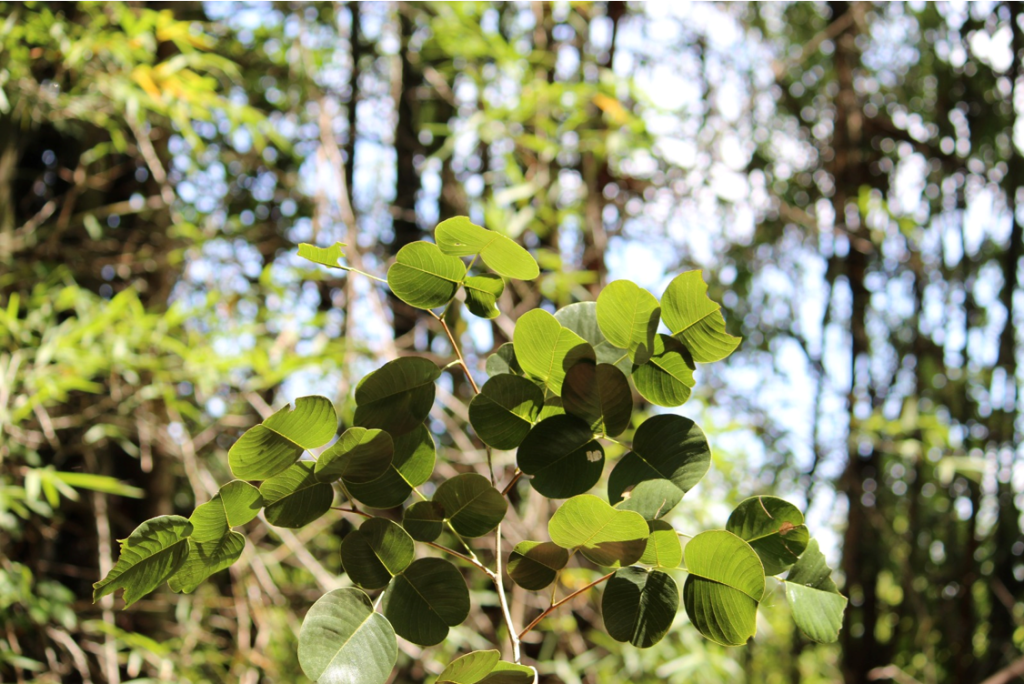
Figure 1: Leaves of P. santalinus
Recent pharmacological investigations have demonstrated numerous biological activities including antioxidant, anti-inflammatory, hepatoprotective, antidiabetic, antimicrobial, anticancer, wound-healing, radioprotective, anti-photoaging, anti-obesity, and neuroprotective effects (Kwon et al., 2006; Kumar et al., 2011; Ghali et al., 2018; Gao et al., 2018; El-Badawy et al., 2019; Reddy et al., 2021; Darshani et al., 2024; Zwirchmayr et al., 2023; Nguyen et al., 2024). Most studies have focused on the heartwood because it contains abundant phenolics, flavonoids, lignans, stilbenoids, and other bioactive constituents responsible for these pharmacological properties (Bulle et al., 2016; Dahat et al., 2021). Despite the growing number of scientific investigations, information regarding the medicinal importance of different plant parts remains scattered. Therefore, the present review compiles published reports on the medicinal uses of P. santalinus (Figure 1), summarizes plant-part-specific pharmacological activities, and identifies research gaps for future studies.
Methodology
A literature-based review was conducted using peer-reviewed publications available in international scientific journals (Sahu et al., 2026). Relevant articles concerning the medicinal uses and pharmacological properties of P. santalinus were collected from the references provided in the present study (Biswas et al., 2004a; 2004b; Bulle et al., 2016a; 2016b). Information on plant parts investigated, biological activities, and therapeutic applications was extracted, organized, and summarized. Duplicate reports were excluded and emphasis was given to experimentally validated pharmacological studies and comprehensive review articles (Kumar, 2025).
Results and discussion
The literature reviewed indicates that P. santalinus possesses a wide range of medicinal properties distributed across different plant parts, although the majority of pharmacological investigations have focused on the heartwood (Table 1). The heartwood exhibited the greatest diversity of biological activities, including antioxidant, anti-inflammatory, antidiabetic, hepatoprotective, hypolipidemic, pancreatic protective, anti-adipogenic, radioprotective, DNA-protective, anti-apoptotic, anti-lipid peroxidation, anti-photoaging, analgesic, wound-healing, anticancer, and potential anti-metabolic syndrome activities. Several studies also demonstrated its insulin-enhancing properties, inhibition of lipid accumulation, and promising drug-likeness based on in vitro and in silico analyses. Compared with the heartwood, relatively fewer investigations have been conducted on other plant parts. Bark has been reported to possess antidiabetic and antidiarrhoeal properties, while seed extracts have demonstrated significant antitumour, antioxidant, anti-inflammatory, hypoglycaemic, hepatoprotective, and nephroprotective activities in experimental studies. Wood powder has primarily been reported as a traditional insect repellent (Table 1). The compiled evidence suggests that although P. santalinus is recognized as a valuable medicinal species with diverse pharmacological potential, research has been concentrated largely on heartwood-derived extracts and their phytochemicals.
Table 1: Medicinal uses of plant parts of P. santalinus
Parts used | Medicinal uses | Source |
Bark
| Antidiabetic | Bulle et al., (2016) |
Diarrhoea | Dahat et al., (2021) | |
Heartwood
| Antioxidant | Bulle et al., (2016) |
Inflammatory disorders | Dahat et al., (2021) | |
Headache | Dahat et al., (2021) | |
Wound healing | Dahat et al., (2021) | |
Anti-inflammatory | El-Badawy et al., (2019) | |
Antioxidant | El-Badawy et al., (2019) | |
Insulin-enhancing | El-Badawy et al., (2019) | |
Hypolipidemic | El-Badawy et al., (2019) | |
Pancreatic protective | El-Badawy et al., (2019) | |
Hepatoprotective | El-Badawy et al., (2019) | |
Anti-adipogenic | Reddy et al., (2021) | |
Anti-inflammatory | Reddy et al., (2021) | |
Reduction of lipid accumulation | Reddy et al., (2021) | |
Potential anti-metabolic syndrome effect | Reddy et al., (2021) | |
Radioprotective potential | Ghali et al., (2018) | |
DNA protective | Ghali et al., (2018) | |
Anti-apoptotic | Ghali et al., (2018) | |
Anti-lipid peroxidation | Ghali et al., (2018) | |
Thiol-restoring activity | Ghali et al., (2018) | |
Antidiabetic potential | Darshani et al., (2024) | |
Drug-likeness and ADMET properties | Darshani et al., (2024) | |
Anticancer activity | Kwon et al., (2006) | |
Analgesic | Dhande et al., (2017) | |
Anti-photoaging effects | Gao et al., (2018) | |
Seeds
| Antitumour activity | Akhouri et al., (2020) |
Antioxidant activity | Akhouri et al., (2020) | |
Anti-inflammatory activity | Akhouri et al., (2020) | |
Hypoglycaemic activity | Akhouri et al., (2020) | |
Hepatoprotective activity | Akhouri et al., (2020) | |
Nephroprotective activity | Akhouri et al., (2020) | |
Wood powder | Insect repellent | Dahat et al., (2021) |
Conclusion
Pterocarpus santalinus is an endangered medicinal tree species with remarkable therapeutic potential, as evidenced by numerous pharmacological studies. The compiled literature demonstrates that the heartwood is the most extensively investigated plant part, exhibiting diverse biological activities such as antioxidant, anti-inflammatory, antidiabetic, hepatoprotective, anticancer, radioprotective, anti-photoaging, analgesic, and anti-adipogenic effects. In comparison, the bark has received limited attention for its antidiabetic and antidiarrhoeal properties, while seed extracts have shown promising antitumour, antioxidant, hypoglycaemic, hepatoprotective, and nephroprotective activities. However, medicinal investigations on leaves, roots, flowers, fruits, pods, and other renewable plant parts remain extremely limited or absent. The predominance of heartwood-based research raises important conservation concerns because harvesting heartwood requires felling the tree, further threatening natural populations of this endangered species. Therefore, future studies should prioritize the phytochemical and pharmacological evaluation of renewable plant parts such as leaves, bark, flowers, fruits, and seeds to identify alternative sources of bioactive compounds. In addition, comprehensive toxicity studies, standardization of extracts, mechanistic investigations, and well-designed clinical trials are required to validate their therapeutic efficacy and safety. Exploring sustainable utilization strategies alongside conservation measures will not only facilitate the development of novel plant-based therapeutics but also contribute to the long-term preservation of P. santalinus.
References
Akhouri V, Kumar A and Kumari M. (2020). Antitumour Property of Pterocarpus santalinus Seeds Against DMBA-Induced Breast Cancer in Rats. Breast Cancer: Basic and Clinical Research. 14: 1178223420951193. https://doi.org/10.1177/11782234209511
Biswas TK, Maity LN and Mukherjee B. (2004a). The clinical evaluation of Pterocarpus santalinus Linn. Ointment on lower extremity wounds–a preliminary report. The International Journal of Lower Extremity Wounds. 3(4): 227–232. https://doi.org/10.1177/1534734604271031
Biswas TK, Maity LN and Mukherjee B. (2004b). Wound healing potential of Pterocarpus santalinus linn: a pharmacological evaluation. The International Journal of Lower Extremity Wounds. 3(3): 143–150. https://doi.org/10.1177/1534734604268385
Bulle S, Reddy VD, Padmavathi P, Maturu P and N CV. (2016a). Modulatory role of Pterocarpus santalinus against alcohol-induced liver oxidative/nitrosative damage in rats. Biomedicine & Pharmacotherapy = Biomedecine & Pharmacotherapie. 83: 1057–1063. https://doi.org/10.1016/j.biopha.2016.08.031
Bulle S, Reddyvari H, Nallanchakravarthula V and Vaddi DR. (2016b). Therapeutic Potential of Pterocarpus santalinus L.: An Update. Pharmacognosy Reviews. 10(19): 43–49. https://doi.org/10.4103/0973-7847.176575
Dahat Y, Saha P, Mathew JT, Chaudhary SK, Srivastava AK and Kumar D. (2021). Traditional uses, phytochemistry and pharmacological attributes of Pterocarpus santalinus and future directions: A review. Journal of Ethnopharmacology. 276: 114127. https://doi.org/10.1016/j.jep.2021.114127
Darshani P, Sarma SS, Gajbhiye RL, Srivastava AK and Kumar D. (2024). Isolation, Characterization, In Vitro and In Silico Assessment of Undescribed Bioactive Constituents from Pterocarpus santalinus L. Heartwood. ACS Omega. 9(50): 49013–49022. https://doi.org/10.1021/acsomega.3c10180
Dhande PP, Gupta AO, Jain S and Dawane JS. (2017). Anti-inflammatory and Analgesic Activities of Topical Formulations of Pterocarpus Santalinus Powder in Rat Model of Chronic Inflammation. Journal of Clinical and Diagnostic Research: 11(7): FF01–FF04. https://doi.org/10.7860/JCDR/2017/25081.10257
El-Badawy RE, Ibrahim KA, Hassan NS and El-Sayed WM. (2019). Pterocarpus santalinus ameliorates streptozotocin-induced diabetes mellitus via anti-inflammatory pathways and enhancement of insulin function. Iranian Journal of Basic Medical Sciences. 22(8): 932–939. https://doi.org/10.22038/ijbms.2019.34998.8325
Gao W, Lin P, Hwang E, Wang Y, Yan Z, Ngo HTT and Yi TH. (2018). Pterocarpus santalinus L. Regulated Ultraviolet B Irradiation-induced Procollagen Reduction and Matrix Metalloproteinases Expression Through Activation of TGF-β/Smad and Inhibition of the MAPK/AP-1 Pathway in Normal Human Dermal Fibroblasts. Photochemistry and Photobiology. 94(1): 139–149. https://doi.org/10.1111/php.12835
Ghali ENHK, Maurya DK and Meriga B. (2018). Radioprotective Properties of Pterocarpus santalinus Chloroform Extract in Murine Splenic Lymphocytes and Possible Mechanism. Cancer Biotherapy & Radiopharmaceuticals. 33(10): 427–437. https://doi.org/10.1089/cbr.2018.2532
Ham B, Kim M, Son YJ, Chang S, Jung SH, Nho CW and Kwon MJ. (2019). Inhibitory Effects of Pterocarpus santalinus extract against IgE/Antigen-Sensitized Mast Cells and Atopic Dermatitis-Like Skin Lesions. Planta Medica. 85(7): 599–607. https://doi.org/10.1055/a-0824-1282
Kumar D. (2011). Anti-inflammatory, analgesic, and antioxidant activities of methanolic wood extract of Pterocarpus santalinus L. Journal of Pharmacology & Pharmacotherapeutics. 2(3): 200–202. https://doi.org/10.4103/0976-500X.83293
Kumar S. (2025). Data collection from literature for biological sciences, medicinal plants research, ethnobotany, and pharmacology: a methodological overview. Journal of Biodiversity and Conservation. 9(2): 167-169.
Kwon HJ, Hong YK, Kim KH, Han CH, Cho SH, Choi JS and Kim BW. (2006). Methanolic extract of Pterocarpus santalinus induces apoptosis in HeLa cells. Journal of Ethnopharmacology. 105(1-2): 229–234. https://doi.org/10.1016/j.jep.2005.10.025
Nguyen LTH, Nguyen NPK, Tran KN, Choi HJ, Moon IS, Shin HM and Yang IJ. (2024). Essential oil of Pterocarpus santalinus L. alleviates behavioral impairments in social defeat stress-exposed mice by regulating neurotransmission and neuroinflammation. Biomedicine & pharmacotherapy = Biomedecine & Pharmacotherapie. 171: 116164. https://doi.org/10.1016/j.biopha.2024.116164
Reddy SK, Ganjayi MS, Oruganti L, Chippada AR and Meriga B. (2021). A bioactive fraction of Pterocarpus santalinus inhibits adipogenesis and inflammation in 3T3-L1 cells via modulation of PPAR-γ/SREBP-1c and TNF-α/IL-6. 3 Biotech.11(5): 233. https://doi.org/10.1007/s13205-021-02771-2
Sahu JK, Sureshrao A, Majhi S, Dimri R, Sharma BP, Tailor V, Kumar S and Patra A. (2026). Methodology for Writing Review Articles in Biological Sciences: A Systematic and Scholarly Guide. Archives of Current Research International. 26(2): 170-182.
Zwirchmayr J, Schachner D, Grienke U, Rudžionytė I, de Martin R, Dirsch VM and Rollinger JM. (2023). Biochemometry identifies suppressors of pro-inflammatory gene expression in Pterocarpus santalinus heartwood. Phytochemistry. 212: 113709. https://doi.org/10.1016/j.phytochem.2023.113709

Dedicated to advancing biodiversity conservation and the sustainable management of natural resources for current and future generations.
Copyright © 2026 Journal of Biodiversity And Conservation || Designed By Antler’s Solution