
Journal of Biodiversity and Conservation 10(3): 1-5
2026
ISSN: 2457-0761 (online)
Makan Prakash Vishwakarma
Department of Botany Government Degree College Rudraprayag, Uttarakhand (Affiliated to Sri Dev Suman Uttarakhand University)
Email-ID: mpvishwakarma62@gmail.com; ORCID: https://orcid.org/0009-0006-2076-0084
DOI: https://doi.org/10.5281/zenodo.21482801
Article Details: Received: 2026-07-07 | Accepted: 2026-07-22 | Available online: 2026-07-23
Licensed under a Creative Commons Attribution 4.0 International License
Abstract: Medicinal mushrooms have long been recognized as valuable natural resources with diverse pharmacological properties and significant therapeutic potential. India possesses a rich diversity of macrofungi, many of which have been documented for their antioxidant, antimicrobial, antiproliferative, antitumor, antihypertensive and gastrointestinal protective activities. The present short communication summarizes the medicinal attributes of twenty-one mushroom species reported from different regions of India based on published scientific literature. The review highlights Ganoderma lucidum, Pleurotus species, Phellinus rimosus, Trametes versicolor and several other species with promising bioactive properties. The compiled information demonstrates that Indian medicinal mushrooms constitute an important reservoir of bioactive compounds that may contribute to future pharmaceutical and nutraceutical development. However, further phytochemical characterization, toxicological evaluation, and clinical validation are essential to facilitate their wider therapeutic application.
Keywords: Antimicrobial activity, antioxidant activity, bioactive compounds, ethnomycology
Introduction
Natural products continue to provide valuable leads for the discovery of novel therapeutic agents, and mushrooms represent one of the most promising groups of organisms owing to their diverse secondary metabolites. Numerous species synthesize polysaccharides, terpenoids, phenolic compounds, proteins, and other bioactive molecules that exhibit antioxidant, antimicrobial, anticancer, anti-inflammatory, and immunomodulatory activities (Bhambri et al., 2022; Panda and Luyten, 2022). India, with its varied climatic zones and rich forest ecosystems, supports a remarkable diversity of wild and cultivated mushrooms that have been traditionally used as food and medicine. Ethnomycological investigations across different parts of India have documented several mushroom species employed by indigenous communities for the treatment of digestive disorders, infections, hypertension, and general health promotion (Panda and Tayung, 2015; Sharma et al., 2022). Scientific investigations have further validated many of these traditional claims by demonstrating antioxidant, antimicrobial, antiproliferative, and antitumor properties in numerous species (Ajith and Janardhanan, 2007; Khan et al., 2016; Ramesh and Pattar, 2010; Tripathy et al., 2014). Keeping the importance of mushrooms in nutritional and medicinal aspects, an attempt has been to gather the medicinal potentials of mushrooms consumed in India and presented in this study. The present communication provides a concise synthesis of the medicinal potential of commonly reported Indian mushrooms based on published literature.
Methodology
A literature-based review was conducted during 2025-2026 using the published references accompanying the compiled dataset (Vishwakarma et al., 2011). Information regarding medicinal mushroom species and their reported pharmacological activities was extracted from peer-reviewed research articles and review papers (Kumar, 2025). Individual mushroom species were categorized according to their documented biological activities, including antioxidant, antimicrobial, antiproliferative, antitumor, antihypertensive, and gastrointestinal protective effects (Sahu et al., 2026). The compiled information was qualitatively synthesized to identify the major therapeutic applications reported for Indian medicinal mushrooms.
Results and discussion
The literature survey identified twenty-one medicinal mushroom species with experimentally or ethnomedicinally reported therapeutic properties (Table 1). Antioxidant activity was the most frequently documented pharmacological effect and was reported for species such as Ganoderma lucidum, Pleurotus florida, Pleurotus pulmonarius, Phellinus rimosus, Inonotus radiatus, Lentinus polychrous, Lenzites betulina, Pycnoporus cinnabarinus and Trametes versicolor. Antimicrobial activity was reported in Cantharellus cibarius, Clavaria vermicularis, Lycoperdon perlatum, Marasmius oreades, Pleurotus pulmonarius and Ramaria formosa. Antiproliferative activity was documented in Agaricus bisporus, Coprinus atramentarius and Pleurotus ostreatus. Both antioxidant and antitumor activities were reported for Ganoderma lucidum, Phellinus rimosus and selected Pleurotus species. Additionally, Volvariella glandiformis was reported to possess blood pressure-lowering activity, while Agaricus californicus, Calvatia bovista and Termitomyces clypeatus were associated with the management of gastrointestinal disorders. Details are listed in Table 1.
Table 1: Some common medicinal mushrooms of India
Name | Medicinal potential | Source |
Agaricus bisporus | Antiproliferative activities | Khan et al., (2016) |
Agaricus californicus | Gastrointestinal disorders | Sharma et al., (2022) |
Calvatia bovista | Gastrointestinal disorders | Sharma et al., (2022) |
Cantharellus cibarius | Antimicrobial activity | Ramesh and Pattar, (2010) |
Clavaria vermiculris | Antimicrobial activity | Ramesh and Pattar, (2010) |
Coprinus atramentarius | Antiproliferative activities | Khan et al., (2016) |
Ganoderma lucidum
| Antioxidant activity | Ajith and Janardhanan, (2007) |
Antitumor activity | Ajith and Janardhanan, (2007) | |
Inonotus radiatus | Antioxidant activity | Tripathy et al., (2014) |
Lentinus polychrous | Antioxidant activity | Tripathy et al., (2014) |
Lenzites betulina | Antioxidant activity | Tripathy et al., (2014) |
Lycoperdon perlatum | Antimicrobial activity | Ramesh and Pattar, (2010) |
Marasmius oreades | Antimicrobial activity | Ramesh and Pattar, (2010) |
Phellinus rimosus
| Antioxidant activity | Ajith and Janardhanan, (2007) |
Antitumor activity | Ajith and Janardhanan, (2007) | |
Pleurotus florida
| Antioxidant activity | Ajith and Janardhanan, (2007) |
Antitumor activity | Ajith and Janardhanan, (2007) | |
Pleurotus ostreatus | Antiproliferative activities | Khan et al., (2016) |
Pleurotus pulmonarius | Antioxidant activity | Ajith and Janardhanan, (2007) |
Antitumor activity | Ajith and Janardhanan, (2007) | |
Antimicrobial activity | Ramesh and Pattar, (2010) | |
Pycnoporus cinnabarinus | Antioxidant activity | Tripathy et al., (2014) |
Ramaria formosa | Antimicrobial activity | Ramesh and Pattar, (2010) |
Termitomyces clypeatus | Gastrointestinal disorders | Sharma et al., (2022) |
Trametes versicolor | Antioxidant activity | Tripathy et al., (2014) |
Volvariella glandiformis | Lower blood pressure | Panda and Tayung, (2015) |
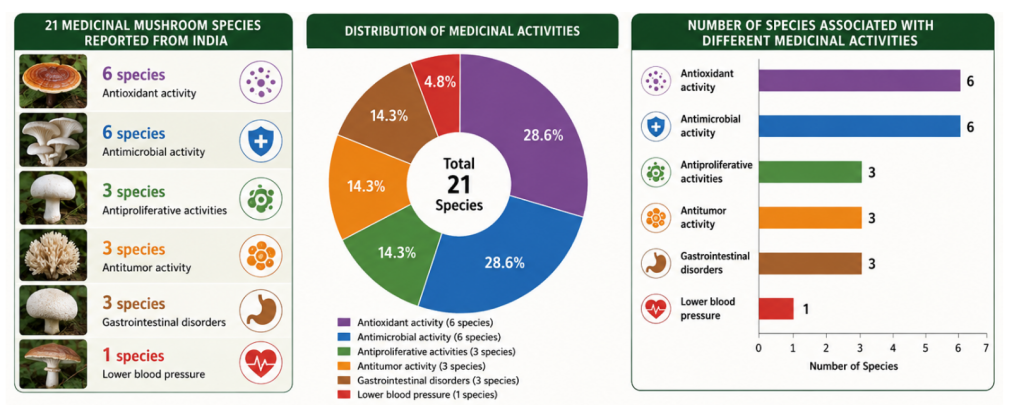
Figure 1: Graphical summary of the medicinal properties of 21 Indian mushrooms
The reviewed literature demonstrated that Indian medicinal mushrooms exhibit a broad spectrum of biological activities (Vishwakarma et al., 2011) attributable to their diverse bioactive constituents (Figure 1). The predominance of antioxidant activity among the surveyed species indicates their potential role in reducing oxidative stress, a major contributor to chronic diseases including cancer, cardiovascular disorders, and neurodegenerative conditions. Mushrooms exhibiting antimicrobial properties may provide alternative sources of natural antimicrobial agents, particularly in view of increasing antimicrobial resistance. Species showing antiproliferative and antitumor activities, especially Ganoderma lucidum and Pleurotus species, have attracted considerable attention because of their potential application in complementary cancer therapy. Furthermore, ethnomedicinal records highlight the importance of indigenous knowledge in identifying therapeutically valuable fungal resources. Despite encouraging findings, most available studies remain limited to laboratory or preliminary investigations. Comprehensive phytochemical analyses, standardization of extracts, toxicity assessments, and well-designed clinical trials are required before these mushrooms can be translated into evidence-based therapeutic products.
Conclusion
Indian medicinal mushrooms represent an important yet underutilized source of pharmacologically active natural products. The available evidence supports their potential as antioxidants, antimicrobial agents, antiproliferative compounds, antitumor agents, antihypertensive remedies, and treatments for gastrointestinal ailments. Continued interdisciplinary research integrating ethnomycology, natural product chemistry, pharmacology, and clinical science will enhance the scientific validation and sustainable utilization of these valuable fungal resources, thereby contributing to future drug discovery and functional food development.
References
Ajith AT and K Janardhanan K. (2007). Indian medicinal mushrooms as a source of antioxidant and antitumor agents. Journal of Clinical Biochemistry and Nutrition. 40(3): 157–162.
Bhambri A, Srivastava M, Mahale VG, Mahale S and Karn SK. (2022). Mushrooms as Potential Sources of Active Metabolites and Medicines. Frontiers in Microbiology. 13: 837266. https://doi.org/10.3389/fmicb.2022.837266
Khan AA, Gani A, Ahmad M, Masoodi FA, Amin F and Kousar S. (2016). Mushroom varieties found in the Himalayan regions of India: Antioxidant, antimicrobial, and antiproliferative activities. Food Science and Biotechnology. 25(4): 1095–1100.
Kumar S. (2025). Data collection from literature for biological sciences, medicinal plants research, ethnobotany, and pharmacology: a methodological overview. Journal of Biodiversity and Conservation. 9(2): 167-169.
Panda MK and Tayung K. (2015). Documentation and ethnomedicinal knowledge on wild edible mushrooms among ethnic tribes of northern Odisha, India. Asian Journal of Pharmaceutical and Clinical Research. 8(4): 139-143.
Panda SK and Luyten W. (2022). Medicinal mushrooms: Clinical perspective and challenges. Drug Discovery Today. 27(2): 636–651.
Ramesh CH and Pattar MG. (2010). Antimicrobial properties, antioxidant activity and bioactive compounds from six wild edible mushrooms of western ghats of Karnataka, India. Pharmacognosy Research. 2(2): 107–112.
Sahu JK, Sureshrao A, Majhi S, Dimri R, Sharma BP, Tailor V, Kumar S and Patra A. (2026). Methodology for Writing Review Articles in Biological Sciences: A Systematic and Scholarly Guide. Archives of Current Research International. 26(2): 170-182.
Sharma R, Sharma YP, Hashmi SAJ, Kumar S and Manhas RK. (2022). Ethnomycological study of wild edible and medicinal mushrooms in district Jammu, J&K (UT), India. Journal of Ethnobiology and Ethnomedicine. 18(1): 23. https://doi.org/10.1186/s13002-022-00521-z
Tripathy SS, Rajoriya A and Gupta N. (2014). Wild mushrooms of Odisha: prospective candidates of antioxidant sources. Adv Plants Agric Res. 1(4):129‒133.
Vishwakarma MP, Bhatt RP and Gairola S. (2011). Some medicinal mushrooms of Garhwal Himalaya, Uttarakhand, India. International Journal of Medicinal and Aromatic Plants. 1(1): 33-40.

Dedicated to advancing biodiversity conservation and the sustainable management of natural resources for current and future generations.
Copyright © 2026 Journal of Biodiversity And Conservation || Designed By Antler’s Solution