
Journal of Biodiversity and Conservation 10(4): 8-10
2026
ISSN: 2457-0761 (online)
Sugaseelan Akash1 and Authinarayanan Rajesh1, 2*
1Department of Botany, Annamalai University, Chidambaram, Cuddalore, Tamil Nadu, India
2Department of Medicinal Botany, Government Siddha Medical College, Palayamkottai, Tirunelveli, Tamil Nadu, India
*Email-ID: tselvarajes@gmail.com; ORCID ID: https://orcid.org/0000-0002-7068-4730
DOI: https://doi.org/10.5281/zenodo.23218350
Article Details: Received: 2026-08-20 | Accepted: 2026-09-30 | Available online: 2026-10-08
Licensed under a Creative Commons Attribution 4.0 International License
Abstract: During floristic exploration in Kanniyakumari District, Tamil Nadu, India, an interesting species was collected and identified as Synsepalum dulcificum (Schumach. & Thonn.) Daniell. This represents the first record of both the genus and species in India, thereby extending its known distribution to the Indian flora. A detailed morphological description of the species is provided, along with images, information on the study area, notes on its habitat, phenology and conservation status.
Keywords: India, New record, Sapotaceae, Synsepalum dulcificum, Taxonomy
Introduction
During an inland floristic survey of Kanniyakumari District, the first author encountered an interesting species of the family Sapotaceae growing in a moist, shady agricultural habitat. The species’ morphology was critically examined using the taxonomic key to the genus within the family Sapotaceae; the recorded morphology matched that of the tropical African genus Synsepalum (A.DC.) Daniell. The overall morphological characteristics correspond precisely with Synsepalum dulcificum (Schumach. & Thonn.) Daniell. Based on the protologue, available literature and herbarium records from the Royal Botanic Gardens, Kew (K), the authors conclude that this genus has not been previously reported from Tamil Nadu.
Taxonomic treatment
Synsepalum dulcificum (Schumach. & Thonn.) Daniell.
Specimen examined: India, Tamil Nadu, Kanniyakumari District, Agasteeswaram taluk, Soorapallam, 45 m, 8°08’53.8″N, 77°21’38.9″E, 14 April 2025, Sugaseelan Akash 631 (AUH).
Description: An evergreen woody shrub up to 8 m tall, with a stem 3–6 cm in diameter. Stem woody, terete, and lenticellate; pubescent when young, becoming glabrous at maturity; branching sympodial. Leaves alternate, simple, oblanceolate, 4.5–8 × 2.5–4 cm, apex acute, base cuneate, margin undulate, green, glabrous; venation pinnate, secondary veins with 12–13 pairs; petiole 4–6 mm long. Inflorescence axillary cyme or rarely solitary. Flower bisexual, up to 8 per cluster, pedicel 3–5 mm long, Calyx gamosepalous, campanulate, tube 2–3 mm long, densely tomentose, brown in colour; lobes 5, triangular, margin entire. Corolla gamosepalous, campanulate, tube 3–4 mm long, creamy white, glabrous; lobes 5, spatulate, 2–3 × 1–2 mm, apex acute, margin entire. Stamens 5, epipetalous; anthers extrorse, longitudinally dehiscent; ovary superior, densely pubescent; style simple; stigma inconspicuous. Fruit a berry, ellipsoidal, 1–1.5 × 0.4–0.6 cm, pubescent, dark red when mature; style persistent. Seed 1, ellipsoidal, 0.6–0.8 × 0.2–0.4 cm, shining, dark brown to black (Figure 1).
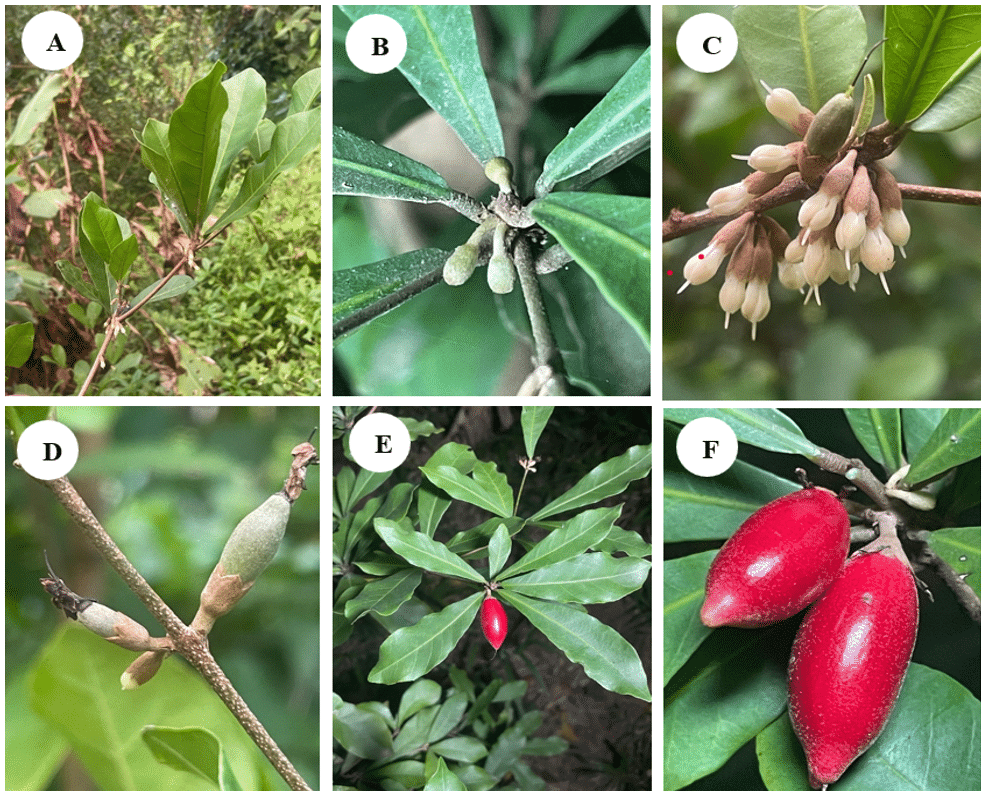
Figure 1: Plant parts of S. Dulcificum; A) Mature twig, B) Bud, C) Inflorescence with cluster of flowers, D) Immature fruit, E&F) Mature fruit
Phenology: Flowering and fruiting throughout the year.
Habitat and ecology: It occurs in agricultural land and grows in association with Cocos nucifera L., Artocarpus hirsutus Lam., Mangifera indica L., Areca catechu L., and Artocarpus heterophyllus Lam.
Conservation status: S. dulcificum was most recently assessed for the IUCN Red List of Threatened Species in 2018 and is categorized as Least Concern, with a stable population trend (BGCI & IUCN SSC Global Tree Specialist Group, 2019).
Global distribution: India: Tamil Nadu (present study); Benin, Cameroon, Central African Republic, Congo, Democratic Republic of the Congo, Gabon, Ghana, Côte d’Ivoire, Nigeria, and Trinidad and Tobago (POWO 2026).
References
Botanic Gardens Conservation International (BGCI) & IUCN SSC Global Tree Specialist Group. 2019. Synsepalum dulcificum. The IUCN Red List of Threatened Species 2019: e.T87719610A147296202. https://dx.doi.org/10.2305/IUCN.UK.20192.RLTS.T87719610A147296202.en. Accessed on 18 September 2026.
POWO (2026). Plants of the World Online. Facilitated by the Royal Botanic Gardens, Kew. Published on the Internet; https://powo.science.kew.org/
Retrieved 18 September 2026.

Dedicated to advancing biodiversity conservation and the sustainable management of natural resources for current and future generations.
Copyright © 2026 Journal of Biodiversity And Conservation || Designed By Antler’s Solution