
Journal of Biodiversity and Conservation 10(3): 50-55
2026
ISSN: 2457-0761 (online)
Bhagwati Prashad Sharma1, Sugimani Marndi2, Brajesh Kumar Sahu3 and Kugarthi Jayalakshmi4*
1Department of Botany, Sidharth Government College, Nadaun, Himachal Pradesh, India
2Department of Botany, Centurion University of Technology and Management, Odisha, India
3Department of Botany, P.M. College of Excellence, Government College, Vidisha, Madhya Pradesh, India
4Department of Biochemistry, Sri Venkateswara University, Tirupati, Andhra Pradesh, India
*Email-Id: jayakugarthi@gmail.com; ORCID: https://orcid.org/0009-0003-1208-8644
DOI: https://doi.org/10.5281/zenodo.21497476
Article Details: Received: 2026-06-26 | Accepted: 2026-07-22 | Available online: 2026-07-23
Licensed under a Creative Commons Attribution 4.0 International License
Abstract: Dienia ophrydis is a terrestrial orchid occurring throughout tropical and subtropical Asia, with an extensive distribution across India. The species inhabits diverse ecological conditions, ranging from moist forest margins and grassy roadsides to humus-rich soils and occasionally occurs as a lithophyte or epiphyte. It is morphologically distinguished by its robust pseudobulbous habit, plicate leaves, dense racemose inflorescence, and minute yellowish to maroon flowers. Beyond its ecological significance, D. ophrydis is recognized for its medicinal importance in traditional healthcare systems, particularly as one of the orchid constituents of the classical Ayurvedic formulation Asthavarga. The species contains the alkaloid malaxin, which has demonstrated promising antimalarial activity against quinine and chloroquine-resistant strains of Plasmodium falciparum. Recent studies have also reported antioxidant, antibacterial, anti-inflammatory and anticancer properties of the whole plant, highlighting its pharmaceutical potential. Despite its wide distribution, habitat degradation, overexploitation and poor natural regeneration pose threats to its long-term survival, emphasizing the need for conservation and sustainable utilization. The article provides a concise account of the taxonomy, morphology, habitat, distribution, ecological significance, medicinal importance and conservation relevance of D. ophrydis, thereby serving as a useful reference for botanists, conservationists and researchers working on orchid diversity and medicinal plants.
Keywords: Antimalarial activity, Asthavarga, Conservation, Distribution, Medicinal orchid
Introduction
Dienia ophrydis (J.Koenig) Seidenf. (Orchidaceae) is a terrestrial orchid (Figure 1) widely distributed across tropical and subtropical Asia, including India, Bhutan, Nepal, Sri Lanka, China, Myanmar, Malaysia, Indonesia, the Philippines, Thailand, Japan, New Guinea and Australia (Singh et al., 2019). In India, it occurs in diverse habitats ranging from the Himalayan foothills to the Western and Eastern Ghats, northeastern states, central India and the Andaman and Nicobar Islands (Singh et al., 2019). The species exhibits remarkable ecological adaptability, growing predominantly in humus-rich, sandy, or clayey soils along forest margins, grassy roadsides and moist shaded habitats, while occasionally occurring as a lithophyte or epiphyte (Singh et al., 2019). Morphologically, it is characterized by robust pseudobulbs, plicate leaves, dense racemose inflorescences and small maroon flowers (Singh et al., 2019). Besides contributing to orchid diversity and forest ecosystem functioning, it is valued in traditional medicine as one of the orchid constituents of the classical Ayurvedic formulation Asthavarga. Phytochemical investigations have identified biologically active compounds such as the alkaloid malaxin, which possesses promising antimalarial activity against quinine and chloroquine-resistant Plasmodium falciparum, while recent studies have also demonstrated antioxidant, antibacterial, anti-inflammatory and anticancer properties of the species (Tinoammini et al., 2025). Despite its broad geographical distribution and considerable medicinal significance, it remains relatively underexplored with respect to its ecology, field identification, habitat preferences and conservation status. Increasing habitat degradation, forest fragmentation, land-use changes and indiscriminate collection for medicinal purposes have contributed to the decline of natural populations in several regions, making conservation and sustainable utilization increasingly important. Although recent advances in tissue culture and ex situ propagation have improved prospects for its conservation, comprehensive information integrating its morphology, distribution, ecology and ethnomedicinal value remains scattered in the literature (Tinoammini et al., 2024). Therefore, the present study aims to compile and synthesize available information on D. ophrydis, highlighting its taxonomic identity, ecological attributes, medicinal importance and conservation significance. Photographs are taken from the field and associated species are recorded and presented in this paper. Such a consolidated account will support future research, facilitate accurate species identification and contribute to evidence-based conservation and sustainable management of this valuable terrestrial orchid.
Morphology
Terrestrial, robust, tufted pseudo bulbous herbs, with the scape; stem is slightly thick in size, slightly compressed, covered with successively larger fleshy sheaths; old pseudobulbs suborbicular, smooth. Leaves ovate-lanceolate to elliptic -lanceolate, acuminate, base oblique, narrowed and sheathed; blade membranous, plicate and edges undulate. This species is robust among all other species. The minute flowers are crowded on a raceme; a strong fold exists between the lateral lobes and the abruptly constricted mid-lobe. Inflorescence peduncle is thick in size, furrowed, with a few deflexed sterile bracts; raceme short and dense- flowered. Flowers minute, light yellow, pale purple or maroon, perianth sparingly gland-dotted. Sepals spreading, margins revolute; dorsal recurved, oblong, subacute; laterals deflexed, oblong-ovate, obtuse. Petals spreading, inflexed, linear- spathulate. Lip spreading, fleshy, subquadrately ovate in outline, obscurely 3-lobed; lateral lobes erect, broad, abruptly constricted at apex to a short, oblong-ovate and rounded mid-lobe (Misra, 2014; Figure 1).
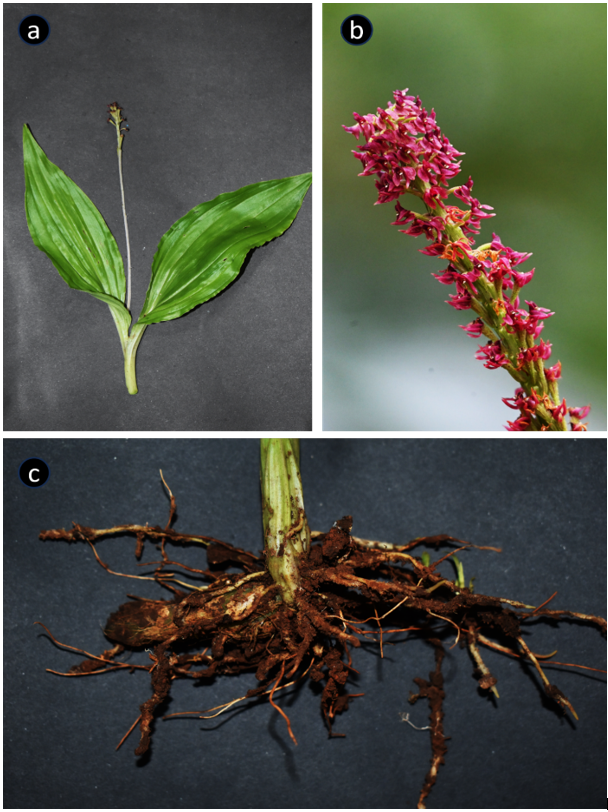
Figure 1: Vegetative parts of Dienia ophrydis; a) Leaves, b) Inflorescence and c) Creeping rhizome
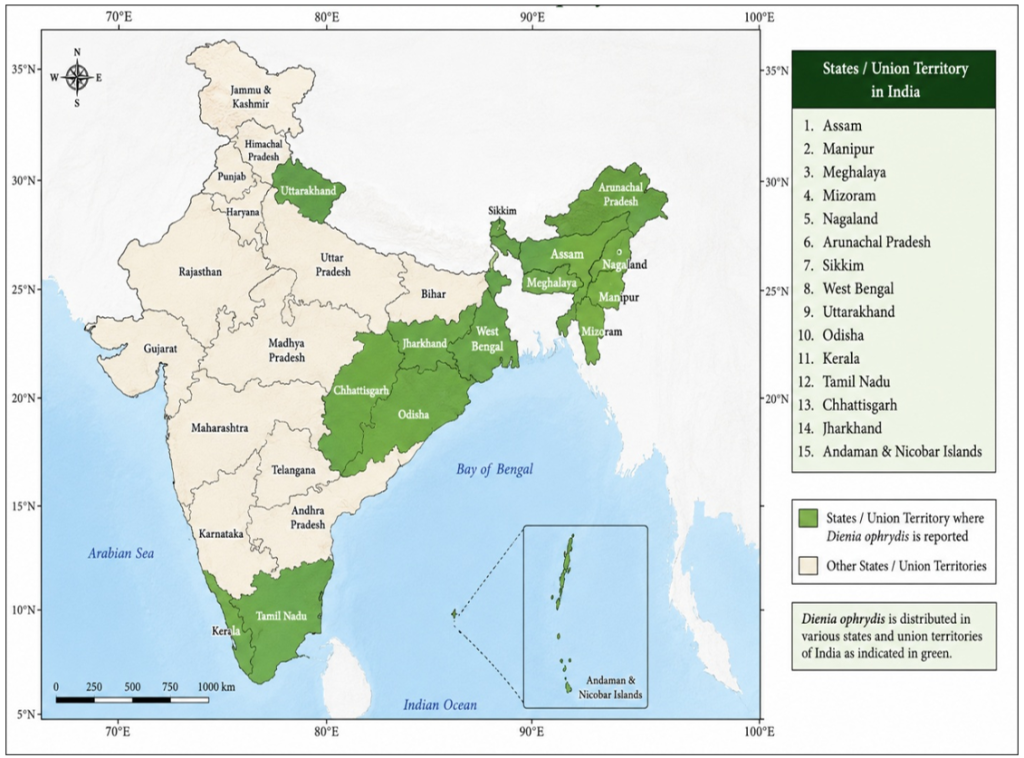
Figure 2: Distribution map of Dienia ophrydis across different states and union territories of India
Flowering season: June-August; anthesis continues for about a month
Fruiting season: July-August
Habitat: This species is primarily terrestrial but may occasionally exhibit epiphytic or lithophytic growth. It inhabits sandy, clayey, or humus-rich soils and is sometimes found growing on rocks or among leaf litter, grasses, and mosses. It generally prefers open habitats such as grassy roadsides and forest margins, although it can also thrive in moist and shaded environments.
Associated flora: It commonly grows in association with several tree, shrub, herb, and grass species in moist deciduous and semi-evergreen forests. It is frequently encountered under the canopy of Shorea robusta Gaertn., and is often associated with Terminalia tomentosa Wight & Arn., Lagerstroemia parviflora Roxb., Madhuca longifolia (J.Koenig ex L.) J.F.Macbr., Syzygium cumini (L.) Skeels, Buchanania lanzan Spreng., Holarrhena pubescens Wall. ex G.Don, and Diospyros melanoxylon Roxb. The herbaceous layer commonly includes species such as Curculigo orchioides Gaertn., and Costus speciosus (J.Koenig) Sm. The orchid usually grows in humus-rich soil among leaf litter, mosses, and grasses in moist, partially shaded habitats along forest margins and open woodland.
Distribution: India (Assam, Manipur, Meghalaya, Mizoram, Nagaland, Arunachal Pradesh, Sikkim, West Bengal, Uttarakhand, Odisha, Kerala, Tamil Nadu, Chhattisgarh, Jharkhand, Andaman & Nicobar Islands), Bhutan, Nepal, Sri Lanka, China, Myanmar, Indonesia, Japan, Malaysia, Philippines, Thailand, New Guinea, Australia (Singh et al., 2019; Kar et al., 2019; Kumar et al., 2021; Kumar et al., 2022; Figure 2).
Medicinal uses: According to the traditional folk medicine of China, Taiwan and Vietnam it revealed that it is used to treat inflammation. Whole plant possess antioxidant, antibacterial and anticancer activity (Tinoammini et al., 2025). Malaxin, an alkaloid first isolated from D. ophrydis, has been reported as an effective antimalarial compound for the treatment of uncomplicated Plasmodium falciparum malaria, particularly against quinine and chloroquine resistant strains. Asthavarga is a renowned traditional Ayurvedic tonic and aphrodisiac formulation composed of eight medicinal herbs. Among its ingredients, four orchid species – Dienia ophrydis (syn. Malaxis muscifera), Crepidium acuminatum (syn. Malaxis acuminata), Habenaria intermedia and Platanthera edgeworthii are of particular importance due to their therapeutic and rejuvenating properties (Nyorak and Riba, 2024). It possesses an anti-malarial alkaloid known as Malaxin (Tnoammini et al., 2024).
Conclusion
Dienia ophrydis is an ecologically and medicinally important terrestrial orchid that contributes significantly to the floristic diversity of tropical and subtropical forests. Its wide distribution, distinctive morphology, and adaptability to diverse habitats make it an important component of natural ecosystems. The species has gained considerable attention due to its traditional medicinal applications, particularly as a constituent of the Ayurvedic Asthavarga formulation and because of its pharmacologically active compounds, including the antimalarial alkaloid malaxin, along with reported antioxidant, antibacterial, anti-inflammatory, and anticancer properties. Despite its therapeutic potential, D. ophrydis faces increasing threats from habitat degradation, forest fragmentation and unsustainable harvesting of wild populations. Strengthening both in situ and ex situ conservation measures, promoting habitat protection and encouraging micropropagation and sustainable cultivation are essential to ensure its long-term survival. Further studies on its ecology, population biology, phytochemistry and cultivation techniques will not only aid in the conservation of this valuable orchid but also facilitate its sustainable utilization in traditional medicine and future pharmaceutical research.
Disclaimer
Author(s) hereby declares that figure 2 is generated with the help of ChatGPT using original data.
References
Kar T, Khora SS and Mandal KK. (2019). Floral diversity of Bonai. Bonai Forest Division. Forest and Environment Department Government of Odisha, India.
Kumar S, Mishra AK, Singh RK, Kumar SN, Marndi S. (2022). Orchids of Bonai Forest Division, a pictorial guide. Divisional Forest Officer, Bonaigarh, Odisha, India.
Kumar S, Mishra S and Mishra AK. (2021). Diversity of orchid species of Odisha state, India. With note on the medicinal and economic uses. Richardiana. 5: 1-26.
Misra S. (2014). Orchids of Odisha, a handbook. Bishen Singh Mahendra Pal Singh, Dehradun, India
Nyorak J and Riba D. (2024). Dienia ophrydis (J.Koenig) Seidenf. (Malaxidinae, Orchidaceae): a vulnerable terrestrial orchid and its ex-situ conservation status in Arunachal Pradesh, India. Pleione. 18(2): 262-266.
Singh SK, Agrawala DK, Jalal JS, Dash SS, Mao AA and Singh P. (2019). Orchids of India- a pictorial guide. Botanical Survey of India, Kolkata. Pp-548.
Tinoammini N, Aazhivaendhan G, Maharaja S and Kumar TS. (2025). Anticancer, antioxidant, and antibacterial activity of the medicinal orchid Dienia ophrydis (J. Koenig) Seidenf. Journal of Phytology. 17: 128-132.
Tinoammini N, Aazhivaendhan G, Thiruppathi, Kumar S. (2024). In-vitro germination and optimization of basal media for protocorm-like bodies proliferation in Dienia ophrydis (J. Koenig) Seidenf. Rhizosphere. 29: 100854. https://doi.org/10.1016/j.rhisph.2024.100854.

Dedicated to advancing biodiversity conservation and the sustainable management of natural resources for current and future generations.
Copyright © 2026 Journal of Biodiversity And Conservation || Designed By Antler’s Solution