
Journal of Biodiversity and Conservation 10(3): 56-60
2026
ISSN: 2457-0761 (online)
Suchetana Mukherjee1, J Jeline Rani2, Saraswati Majhi3, Tapan Kumar Samal4, Brajesh Kumar Sahu5, Sugimani Marndi6 and Maofungsar Basumatary7*
1Department of Botany, Bejoy Narayan Mahavidyalaya, Itachuna, Hooghly, West Bengal, India
2Department of Botany, Bishop Heber College, Tiruchirappalli, Tamil Nadu, India
3P. G. Department of Botany, Shailabala Women’s Autonomous College, Cuttack (affiliated to Rama Devi Women’s University, Bhubaneswar), Odisha, India
4Department of Botany, Gorumahisani Iron Higher Secondary School, Gorumahisani, Rairangpur, Mayurbhanj, Odisha, India
5Department of Botany, P.M. College of Excellence, Government College, Vidisha, Madhya Pradesh, India
6Department of Botany, Centurion University of Technology and Management, Odisha, India
7Hemvati Nandan Bahuguna Garhwal University, Srinagar, Uttarakhand, India
*Email-Id: maofungsarb32@gmail.com; ORCID: https://orcid.org/0000-0003-2985-386X
DOI: https://doi.org/10.5281/zenodo.21512199
Article Details: Received: 2026-06-26 | Accepted: 2026-07-22 | Available online: 2026-07-23
Licensed under a Creative Commons Attribution 4.0 International License
Abstract: Dendrobium regium is an endemic epiphytic orchid distributed across central, eastern and northeastern India, where it inhabits tropical moist deciduous and semi-evergreen forests. The present note provides a concise account of its morphology, habitat preferences, geographical distribution, associated host tree species, ecological significance and ethnomedicinal importance. The species is characterized by stout tufted stems, large magenta flowers with a yellow-throated lip and a flowering period extending from April to July. It predominantly grows as an epiphyte on mature forest trees under shaded and humid conditions. The orchid contributes to forest canopy biodiversity, supports pollinator communities, and serves as an indicator of relatively undisturbed forest ecosystems. Traditional medicinal uses include the treatment of sickle cell anemia in Nagaland and bone fractures in Jharkhand. Owing to its restricted distribution, habitat specificity and vulnerability to forest degradation and overexploitation, in situ conservation and sustainable management are urgently needed. Present study highlights the ecological and ethnobotanical importance of the species.
Keywords: Biodiversity, conservation, endemism, epiphyte, ethnomedicine, pollination
Introduction
Orchids constitute one of the largest and most diverse families of flowering plants, comprising more than 30,000 species worldwide (Singh et al., 2019; Kindlmann et al., 2023). India is recognized as one of the major centres of orchid diversity, harboring over 1,484 species distributed across the Himalayan region, North-East India, the Western Ghats, and parts of the Eastern Ghats and central India (Kumar et al., 2022). Among them, species of the genus Dendrobium Sw. are particularly valued for their remarkable floral diversity, horticultural importance, medicinal properties and ecological significance (Mety et al., 2024). Epiphytic Dendrobium species play an important role in maintaining forest canopy biodiversity by providing microhabitats for associated organisms and supporting pollinator communities. However, many native species remain poorly documented with respect to their ecology, distribution, and conservation requirements. Dendrobium regium Prain (Figure 1) is an endemic epiphytic orchid of India, occurring in tropical moist deciduous and semi-evergreen forests of Nagaland, Andhra Pradesh, Odisha, Chhattisgarh, Jharkhand and Madhya Pradesh (Singh et al., 2019; Kumar et al., 2021; Kumar et al., 2022b). The species is distinguished by its large magenta flowers and its preference for mature forest trees growing under humid, shaded conditions. Besides its ornamental value, it has ethnomedicinal importance. Its occurrence is closely associated with old-growth forest stands, making it a useful indicator of healthy forest ecosystems. Nevertheless, habitat degradation, forest fragmentation, indiscriminate collection and declining host tree populations pose significant threats to its natural populations. Despite its ecological and ethnobotanical importance, comprehensive information on the habitat ecology, host tree association, distribution and conservation significance of D. regium remains scattered in floristic accounts and regional reports. The absence of a consolidated ecological note limits its effective conservation and management. Therefore, the present study aims to provide a concise account of the morphology, habitat, associated tree species, geographical distribution, ecological value and traditional medicinal uses of D. regium. For taking photographs and ecological significance, a field study was also carried out in Odisha state during 2023-2025. Present study seeks to enhance understanding of the species and emphasize the need for habitat protection, in situ conservation, future ecological and propagation studies for this endemic orchid of India.
Morphology
Tufted stout epiphytes, leafy on the upper halves; stem are thick in size, thickened at the nodes, striate, compressed, narrowed to base; old stems turn slightly yellowish. Leaves alternate, distichous, sessile oblong, subobtuse, obliquely notched at apex. Inflorescence one-two, subterminal, racemose on a short peduncle from leafy or leafless stem, with two-four flowers. Bracts imbricating, scarious, oblong, rounded, persistent. This species is distinguished by a few large flowers with broad tepals of magenta colour and an undivided lip of the same colour with yellow throat. Flowers handsome, magenta, deeper along the veins and veinlets, perianth spreading, fleshy. Sepals subequal, oblong- elliptic, rounded; laterals oblique and connate with column foot forming a short conical, blunt mentum. Petals much broader, ovate, obtuse, clawed at base. Lip broadly ovate, obtuse, shortly clawed, basal one-third rolled over the column, margin deflexed; lower half-light yellow, deeper towards the base; upper half magenta.
Flowering season in the month of April- July, occasionally up to July; flowers last for 3-4 weeks (Saxena and Brahmam 1995; Mishra, 2014).
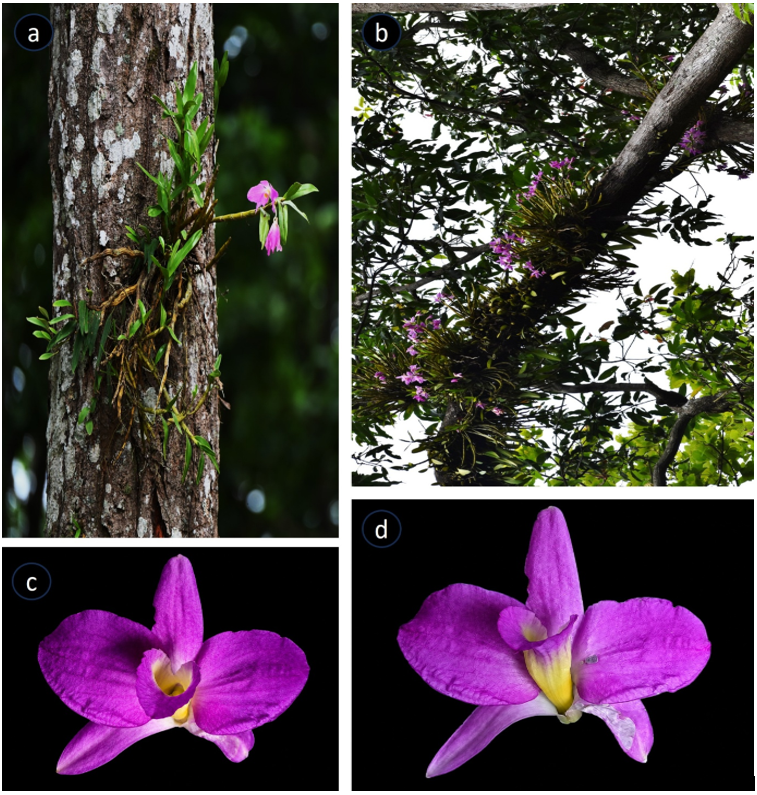
Figure 1: Morphology of Dendrobium regium a) Whole plant of D. regium, b) Habit, c) Front view of inflorescence and d) Down view of inflorescence
Habitat
In tropical moist deciduous to semi-evergreen forest, under shaded conditions; occasionally lithophytic.
Associated tree species
Shorea robusta, Buchanania lanzan, Syzygium cumini, Anogeissus latifolia, Mangifera indica, Terminalia tomentosa, Terminalia bellirica, Madhuca longifolia and Pterocarpus marsupium.
Distribution
Nagaland, Andhra Pradesh, Odisha, Chhattisgarh, Jharkhand and Madhya Pradesh.
Medicinal uses
The ethnomedicinal significance of Dendrobium regium has been documented across different regions of India. In Nagaland, the species is traditionally used in the management of sickle cell anemia (Deb et al., 2015), while in Jharkhand it is used for treating bone fractures (Kumar and Kumar, 2020).
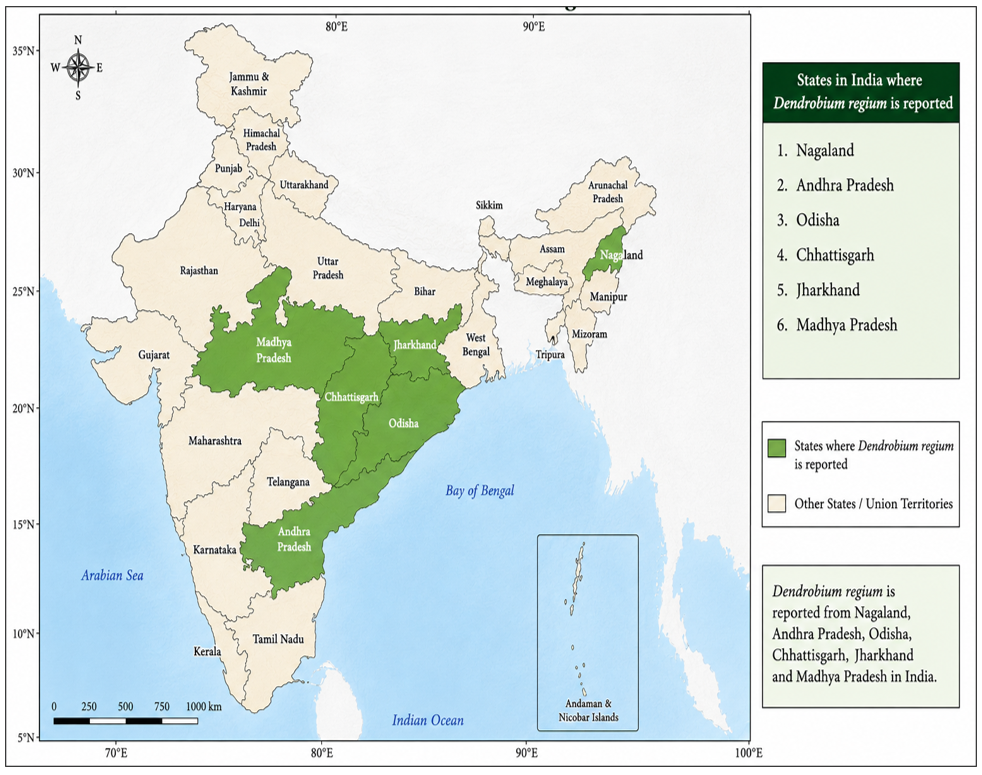
Figure 2: Geographical distribution of Dendrobium regium in India
Ecological value: It is an ecologically important endemic epiphytic orchid that contributes to the biodiversity and structural complexity of tropical moist deciduous and semi-evergreen forests of India. As an epiphyte, it grows on mature trees without extracting nutrients from the host, thereby increasing canopy diversity and providing microhabitats for small invertebrates and associated microorganisms. Its preference for old-growth trees such as Shorea robusta, Syzygium cumini, Terminalia species and Pterocarpus marsupium makes it a useful indicator of relatively undisturbed forest ecosystems with high humidity and stable microclimatic conditions. The large, brightly coloured magenta flowers provide nectar and visual cues for pollinating insects, supporting local pollinator networks during its flowering period from April to July. Because of its restricted distribution, habitat specificity and sensitivity to forest degradation, canopy removal and over-collection, D. regium also serves as a valuable flagship species for the conservation of forest canopies and epiphytic orchid diversity in central, eastern and northeastern India.
Conclusion
Dendrobium regium Prain is a valuable endemic epiphytic orchid of India with significant ecological, ornamental and ethnomedicinal importance. Its close association with mature trees in tropical moist deciduous and semi-evergreen forests highlights its dependence on stable forest ecosystems and its potential role as an indicator of habitat quality. The species contributes to canopy biodiversity, supports pollinator interactions and possesses documented traditional medicinal uses among indigenous communities. However, habitat degradation, forest fragmentation and unsustainable collection pose increasing threats to its natural populations. The present note consolidates available information on the morphology, habitat, distribution, host tree associations, ecological value and medicinal importance of D. regium, thereby providing a useful baseline for future research. Long-term monitoring of natural populations, protection of host trees and forest habitats, ex situ propagation and community-based conservation initiatives are essential to ensure the sustainable conservation of this endemic orchid in its natural range.
References
Deb CR, Dey S and Jakha HY. (2015). Report of Dendrobium regium Prain (Orchidaceae) from Nagaland, India – a new record from North-East India. Pleione. 9(1): 258-260.
Kindlmann P, Kull T and McCormick M. (2023). The distribution and diversity of orchids. Diversity.15: 810.
Kumar A and Kumar S. (2020). Some medicinal orchid species of Jharkhand, India. Journal of Biodiversity and Conservation. 4(4): 398-404.
Kumar S, Devi RS, Choudhury R, Mahapatra M, Biswal SK, Kaur N, Tudu J and Rath SK. (2022a). Orchid diversity, conservation and sustainability in Northeastern India. In: Furze JN, Eslamian S, Raafat SM and Swing K (Ed.). Earth System Protection and Sustainability, Volume 1. Springer, Switzerland.
Kumar S, Mishra AK, Singh RK, Kumar SN, Marndi S. (2022b). Orchids of Bonai Forest Division, a pictorial guide. Divisional Forest Officer, Bonaigarh, Odisha, India.
Kumar S, Mishra S and Mishra AK. (2021). Diversity of orchid species of Odisha state, India. With note on the medicinal and economic uses. Richardiana. 5: 1-26.
Mety SS, Marndi S and Kumar S. (2024). Medicinally important Dendrobium species of India. Medico Bio-wealth of India. Volume 15. Ambika Prasad Research Foundation, Odisha, India
Misra S. (2014). Orchids of Odisha, a handbook. Bishen Singh Mahendra Pal Singh, Dehradun, India.
Saxena HO and Brahmam M. (1995). The flora of Orissa. Volume 3. Regional Research Laboratory, Odisha and Orissa Forest Development Corporation Ltd., Bhubaneswar, Odisha, India.
Singh SK, Agrawal DK, Jalal JS, Dash SS, Mao AA, Singh P (2019). Orchids of India; a pictorial guide. Botanical Survey of India, Calcutta, West Bengal, India.

Dedicated to advancing biodiversity conservation and the sustainable management of natural resources for current and future generations.
Copyright © 2026 Journal of Biodiversity And Conservation || Designed By Antler’s Solution