
Journal of Biodiversity and Conservation 10(3): 121-138
2026
ISSN: 2457-0761 (online)
Shreyas Betageri1*, Manjushree S. Kanoj2, Vanaja G. Patgar2 and K. Kotresha2
1J.S.S Banashankari Arts, Commerce and Shantikumar Gubbi Science College, Vidyagiri, Dharwad, Karnataka, India
2Taxonomy and Floristic Laboratory, Department of UG, PG and Research in Botany, Karnatak University, Karnataka Science College, Dharwad, Karnataka, India
*Email-Id: shreyasbetgari@gmail.com; ORCID: https://orcid.org/0000-0002-6554-2965
DOI: https://doi.org/10.5281/zenodo.22920391
Article Details: Received: 2026-08-30 | Accepted: 2026-09-07 | Available online: 2026-09-24
Licensed under a Creative Commons Attribution 4.0 International License
Abstract: Carnivorous plants are specialized plants that derive some or most of their major nutrients by trapping and digesting small animals, typically insects and other arthropods. In India, there are a total of 44 species of carnivorous plants and Karnataka has 2 families of carnivorous plants, i.e. Droseraceae and Lentibulariaceae. Droseraceae represents 3 species. Exploration of carnivorous plants from Karnataka collected Drosera genus with three species, dissected the specimens, conducted pollen and seed morphometry using SEM and recorded secondary data on the distribution of Droseraceae in South India.
Keywords: Carnivorous herbs, D. burmanii, D. indica, D. peltata, glands, spiny surface, testa cells
Introduction
Carnivorous plants are specialized plants that derive some or most of their major nutrients by trapping and digesting small animals, typically insects and other arthropods. They have evolved unique adaptations to grow in nutrient-poor environments, especially soils that lack sufficient nitrogen or phosphorus; this unique trait allows them to survive and prosper in habitats such as bogs, fens and sandy soil, where other plants might struggle. Approximately 860 species of carnivorous plants under 20 genera of 12 families were reported in the world; they are Lentibulariaceae, Droseraceae, Nepenthaceae, Sarraceniaceae, Cephalotaceae, Drosophyllaceae, Byblidaceae, Roridulaceae, Bromeliaceae, Eriocaulaceae, Stylidiaceae and Martyniaceae (Adam et al., 2020). In India, a total of 44 species of carnivorous plants under 5 genera belonging to 3 families, they are Droseraceae, Lentibulariaceae and Nepenthaceae, were reported, viz. Utricularia (38 species), Drosera (3 species), Nepenthes (1 species), Pinguicula (1 species) and Aldrovanda (1 species) (Santapau and Henry, 1976; Singh and Sanjappa, 2011; Zaman et al., 2011; Kamble et al., 2012). In Karnataka, 2 families of carnivorous plants are reported, i.e. Droseraceae and Lentibulariaceae. Droseraceae represents 3 species. Flora of Bangalore district by Ramaswamy and Razi, (1973) documented a total 2 species, under 1 genus, D. burmanni and D. indica. Flora of Hassan district by Cecil J. Saldanha and Dan H. Nicolson, (1976) recorded 3 species under 1 genus, D. burmanni, D. indica and D. pelteta. A Synoptic Flora of Mysore district by Rao and Razi, (1981) reported species 3 under 1 genera, D. burmanni, D. indica and D. peltata. Flora of Chikmagalur district, Karnataka, India by Yognarsimhan et al., 1981 have listed 2 species under 1 genus D. burmanni and D. peltata. Flora of Karnataka Analysis by Sharma et al., (1984) has 3 species under the 1 genus, D. burmanni, D. indica and D. pelteta. Flora of Eastern Karnataka written by N. P. Singh, (1988) reported 2 species, 1 genus, D. burmanni and D. indica. Flora of Coorg (Kodagu) Karnataka, India by Keshava Murthy and Yoganarasimhan, (1990) have reported the 3 species, D. burmanni, D. indica and D. peltata under 1 genus. Flora of Gulberga district by Seetheram et al., (2000) has not reported any species. Flora of Shivmogga district by Ramaswamy et al., (2001) has reported 2 species under 1 genus, D. burmanni and D. indica. Flora of Udupi district by Gopalkrishna Bhat, (2003) reported 2 species under 1 genus, D. burmanni and D. indica. Flora of Anshi National Park by Laxminarasimhan and Punekar, (2011) have reported 2 species under 1 genus, D. burmanni and D. indica. Flora of Tumkur district by Baskar and Kushalappa, (2014) have reported 2 species, under 1 genus, D. burmanni and D. indica Flora of South Kanara has not reported any species.
Flowering plants of Western Ghats, India by Nayar et al., (2014) have reported 3 species, under 1 genus, D. burmanni, D. indica and D. pelteta. Flora of Gadag district by Kotresha and Kambhar, (2016) have reported 2 species under 1 genus, D. burmanni, D. indica. Flora of Haveri have reported 1 species, under 1 genus, D. indica. Flora of Bidar district, Karnataka by Seetharam et al., (2018) have reported 1 species under 1 genus, D. indica. Flora of Kolar district by Yoganarsimhan et al., (2018) have reported 1 species under 1 genus, D. burmannii. Floristic diversity status and utility in Raichur district by Savita and Kotresha reported 2 species under 1 genus, D. buramnnii and D. indica. Numerous floristic studies have documented the occurrence of Drosera species across Karnataka and other parts of South India (Ramaswamy and Razi, 1973; Saldanha and Nicolson, 1976; Rao and Razi, 1981; Sharma et al., 1984; Nayar et al., 2014). However, these studies primarily focused on taxonomy, distribution of species and comparative pollen and seed morphometric analyses remain limited. SEM Photographs of pollen and seed provide taxonomic evidence for species.
Pollen and seed morphometric works
The genus Drosera has pollen with a proximal aperture and an extremely peculiar structure (Kuprianova, 1973). The heteropolar pollen grains of Drosera (Droseraceae) are united into permanent tetrads. These tetrads have unique, complex internal set-ups, the apertures (pores) are situated equatorially and show protrusions along the borders of adjoining pollen grains, which are enclosed by a thick intine and emerge from the apertures. The tetrahedral tetrads sometimes are shifted to a small degree, mimicking tetragonal tetrads depending on the species and degree of hydration. Pollen ornamentation in all investigated Drosera species is echinate with numerous small bacula or clavae between the echini. Number and length of the echini differ considerably in a species-to-species manner. Pollen tetrad in Drosera seems to be one of the most intricate pollen grains in angiosperms. Drosera burmanni has pollen grains similar to those of Drosera sessilifolia, showing no developed cross wall, possession of aperture type 6, but the processes of the former are somewhat differentiated into the larger (0.4 µm in diameter) and the smaller ones (less than 0.2 µm in diameter). On examining the pollen grain under a light microscope; D. burmannii has 20-30 proximal pores per unit area and absence of cross wall. Pores lining along the connection area, about 15 in number arranged in a whorl. In electron microscope, spinules are 1.9 µm long and 0.4-0.7 µm wide at the base; about 100 in number per unit area. The shape of spine-like projections is variable from specimen to specimen. Whereas, D. indica pollen grains observed under a light microscope show united tetrahedral tetrads by cross wall cohesion. Each grain provided with one central pore, 8-12 developed channels and has type 7 aperture and the pollen grain processes pinular layer 1.5-1.9 µm thick. In electron microscope, spines l.8-2.3 µm long and 0.7 µm wide at base, 5-8 in number per unit area. Spinules 0.5 um long and 0.2 µm wide at base, drumstick in shape, 100 or more in number per unit area and basal layer 1 µm thick (Takarashi and Sorma, 1982). The present study provides a comparative scanning electron microscopy SEM investigations of pollen and seed analysis of all three Drosera species occurring in South India, namely D. burmannii, D. indica and D. peltata. Provided morphometric data helps to evaluate interspecific variation and to identify characters useful for species identification. The present study provides a comparative SEM-based evaluation of pollen tetrads, seed and testa cell patterns of D. burmanii, D. indica and D. peltata.
Material and methods
Study area: South Indian states include Andhra Pradesh, Telangana, Karnataka, Kerala and Tamil Nadu. Karnataka, Kerala and Tamil Nadu records Western Ghats side by Arabian sea. Andhra Pradesh, Telangana and Tamil Nadu records Eastern Ghats. Western Ghats covers evergreen, semi-evergreen, moist deciduous, shola grasslands, riparian vegetation and scrubby forests. Eastern Ghats covers tropical evergreen, semi-evergreen, and moist deciduous to dry savannah and scrub forests.
Micro (pollen) and macroscopic (seed) analysis: Fresh flowers and mature fruits of each species were collected during field surveys. Pollen grains were examined under a light microscope for preliminary observations, while mature seeds were used for scanning electron microscopic (SEM) analysis. Seed samples were mounted on aluminium stubs using double-sided carbon adhesive tape, sputter-coated with gold and examined under SEM following the procedure described by Deshi et al., (2025).
Scanning electron microscopy (SEM) and morphometric analysis of pollen and seeds: For each of the three Drosera species, three mature flowering individuals collected from natural populations were examined. Herbarium specimens were prepared following standard herbarium techniques (Rao and Jain, 1976) and deposited in the Herbarium of Karnatak Science College, Dharwad (HKSCD).
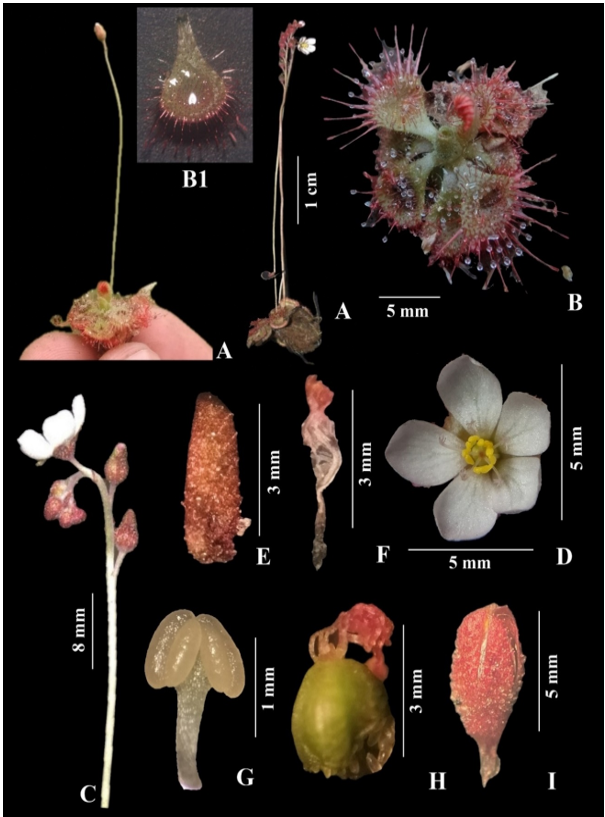
Figure 1: Drosera burmannii Vahl A. Habit, Flower bearing plant; B. Foliar organs (Rosette); B1. Leaf/Individual foliar organ C. Inflorescence; D. Flower; E. Single calyx; F. Corolla; G. Anther; H. Ovary with stigma; I. Fruit
Results and discussion
During exploration of Karnataka from Western Ghats and transition zone collected three Drosera spp. from different location. Studied its morphology, pollen morphometry and seed morphometry.
Taxonomic treatment
Droseraceae Salisb. n Parad. Lond. 2: ad t. 95. 1808 [1 Feb 1808] (1808) nom. cons.
Submerged aquatic carnivorous herbs. Leaves are stalked, confined to the base of plant forming basal rosettes, rarely alternate or whorled, leaf blade with sticky glandular trichomes that secrete drops of mucilage at their tips. Insects attracted by scent drops of mucilage become struck and ultimately digested for food. The inflorescence is raceme, terminal, cymose, paniculate and rarely solitary. Flowers are actinomorphic, bisexual, ebracteate. Sepals 5-8, imbricate, persistent. Petals 5-8, polypetalous, alternating with sepals. Stamens usually 5, alternating with perianth, anthers extrose. Superior ovary. Fruits are loculicidal capsules that have seeds when it ripe. Seeds 3 to numerous.
Drosera L. Sp. Pl.: 281 (1753): Annual or perennial insectivorous herbs with pseudo-roots on which tubers are sometimes formed. Stem very short, long, erect or climbing. Leaves in basal rosette or caulescent and alternate with glandular, papillose hairs, the lamina with sticky glands which trap small insects. Inflorescence racemose or cymose. Flowers bisexual, actinomorphic, 1 to many. Sepals usually 5, free or connate at base. Petals 5, free. Stamens as many as petals. Ovary superior, style 3-5 free or connate at base. Fruit is a capsule. Seeds small and numerous, ellipsoid or linear, sometimes winged.
Key to Drosera species
1 | Leaves rosette, spathulate shape | 2 |
1 | Leaves tentacles, Flower pink | D. indica |
2 | Leaves green erect from the soil up to 5 cm | D. peltata |
2 | Leaves red spreading above soil up to 2 cm | D. burmanii |
Drosera burmannii Vahl. Symb. Bot. 3: 50. 1794; Cooke, Fl. of Presidency of Bombay 1: 499. 1905; Gamble, Fl. of Presidency of Madras 1: 452. 1905; Ramaswamy & Razi, Fl. Bangalore 210. 1973; Saldanha & Nicolson Fl. Hassan 159. 1976; Rao & Razi, Fl. Mysore 416. 1981; Yoganarasimhan et al., Fl. Chikamagalur 135. 1981; Saldana, Fl. Karnataka 265. 1996; Fl. Eastern Karnataka 304. 1988; Keshavamurthy & Yoganarasimhan, Fl. Coorg, 182. 1990; Ramaswamy et al., Fl. Shivmogga 223. 2001; Bhat, Fl. Udupi, 199. 2003; Manjunath et al., Fl. Davanagere 173. 2004; Punekar & Laxminarasimhan, Fl. Anshi National Park, 213. 2011; Baskar & Kushalappa, Fl. Tumkur 109. 2014; Bhat, Fl. South Kanara 589. 2014; Nayar et al., Fl. Flowering Plants of Western Ghats 328. 2014; Yoganarasimhan et al., Fl. Kolar, 166. 2018 (Figure 1-2).
Small, annual, rosette, acaulescent, carnivorous plant, round, 2-4 cm in diameter. Stem elongated, basal rosette with leaves. Leaves arranged compact, ground-hugging rosette, spoon-shaped, with broad, circular to oval laminae, 5-10mm long, leaves covered with glandular hairs, greenish pink. Flowers are small, white, 4-5 mm in diameter, actinomorphic. Petals are 5, free, slightly overlapping. Sepals are green, hairy and glandular. Stamens are 5 and free, filaments are slender & white, yellow anther. 3 fused carpels, superior ovary, unilocular, multiple ovules. 3 or more styles, slender, branched stigma. Fruit is simple, small, dehiscent capsule. Ovoid or spherical, multiple seeds, less than 1mm, dark brown to black, lightweight.
Place of collection: Surla, Belagavi
Date of Collection: 24/10/2024
Collector No.: 22
Flowering & fruiting: October-February
IUCN Status: Least concern
Vernacular name: Tropical Sundew, Mukhajali, Krimibamdha
Nativity: Bangladesh, Bismark, Borneo, Combodia, Caroline Is., China, Hainan, India, Java, Laos, Lesser Sunda Is., Malaya, Maluku, Myanmar, Nepal, New Caledonia, New Guinea, New South Wales, New Territory, Philippines, Queensland, Sri Lanka, Sulawesi, Taiwan, Thailand, Western Australia.
Distribution: Karnataka: Shivmogga district, R. Ramesha and P. Sreenath, KFP7371, 1979; Anantapur district, K. Raja, Photo ID: HJB-E-310, 2014; Uttar Kannada district, 24032011 pj3, 2010; Uttar Kannada district, Dhruva Bhat and Hosmani P.A, 31-5-2025; Tumkur district, T.S.P Kumar, Photo ID: TSPOCT2015-45, 2015. Dandeli, Uttar kannada district, Radhadevi, A 2003; Banglore Urban district district, Ravikumar K, and Ved D.K. (2000). Andhra Pradesh: Shrikakulam district, Rolla Seshagiri, S. Hara Sriramulu, 1986; Visakhapatnam district, K. Jayaram and M.N.V Prasad, 2006. Kerala: Palakkad district, Praveenkumar K, 14-12-2018; Idukki district, K.S.Sudhi, 2016; Vagamon district K. S. Sudhi, 2-6-2016. Thrissur district, Sasidharan N, 2004. Tamil Nadu: Madurai district, K. Natrarajan, R. Kottaimuthu et al., 1-12-2008; Tripur district, Koushik Majumdar, B. K. Datta and Uma Shankar, 12-11-2010. Madurai district, K. Natarajan, R. Kottaimuthu et al., 2008. Telangana: Khammam district, K. Jayaram and M.N.V. Prasad, 2006. Chhattisgarh: Udanti – Sitanadi Tiger Reserve-Oddh Kulkadighat range, Faiz bux, Suraj M, Ahmed M.K et al., 2021. Odisha: Karlapat, Prasad Kumar Dash, Photo ID: 251011PD 01, 11-2-2011. Maharashtra: Pune district, Savita S. Rahangdale and Sanjaykumar, R. Rahangdale 2-1-2021.
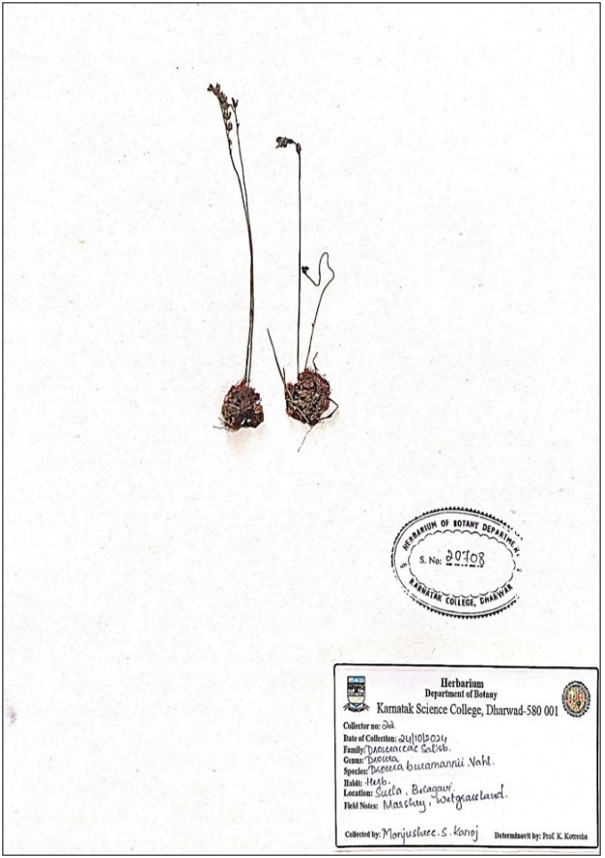
Figure 2: Herbarium of Drosera burmannii Vahl submitted to HKSCD
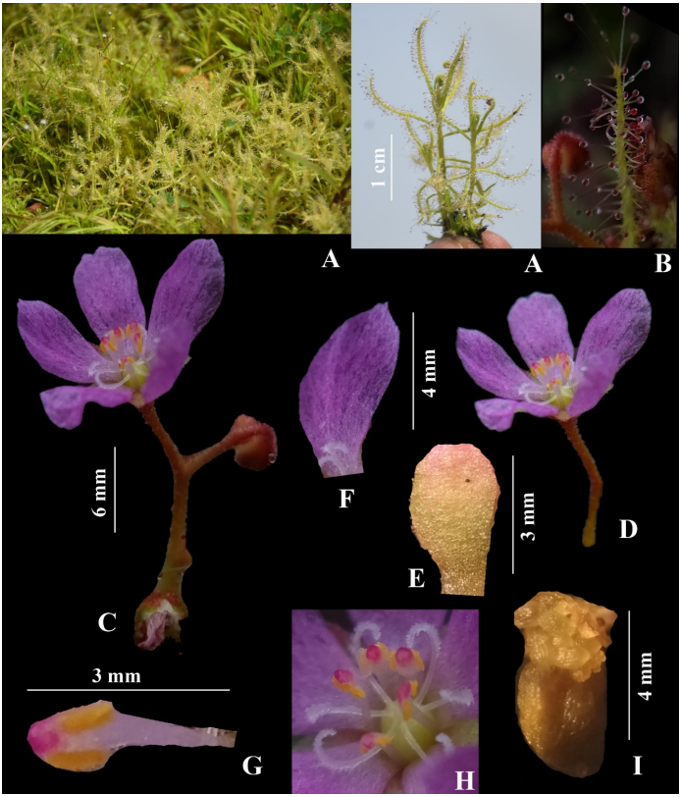
Figure 3: Drosera indica L. A. Habitat; A. Habit; B. Tentacles; C. Inflorescence; D. Flower; E. Calyx; with seeds F. Petal; G. Anther; H. Stamens; I. Ovary
Drosera indica L. Sp. Pl.: 282 (1756); Symb. Bot. 3: 50. 1794; Cooke, Fl. of Presidency of Bombay 1: 499. 1905; Gamble, Fl. of Presidency of Madras 1: 452. 1905; Ramaswamy & Razi, Fl. Bangalore 211. 1973; Saldanha & Nicolson Fl. Hassan 159. 1976; Rao & Razi, Fl. Mysore 416. 1981; Saldana, Fl. Karnataka 267. 1996; Sharma et al., Fl. Karnataka Analysis 0. 1984; Singh, Fl. Eastern Karnataka 304. 1988; Keshavamurthy & Yoganarasimhan, Fl. Coorg, 182. 1990; Ramaswamy et al., Fl. Shivmogga 224. 2001; Bhat, F l. Udupi, 199. 2003; Punekar & Laxminarasimhan, Fl. Anshi National Park, 213.
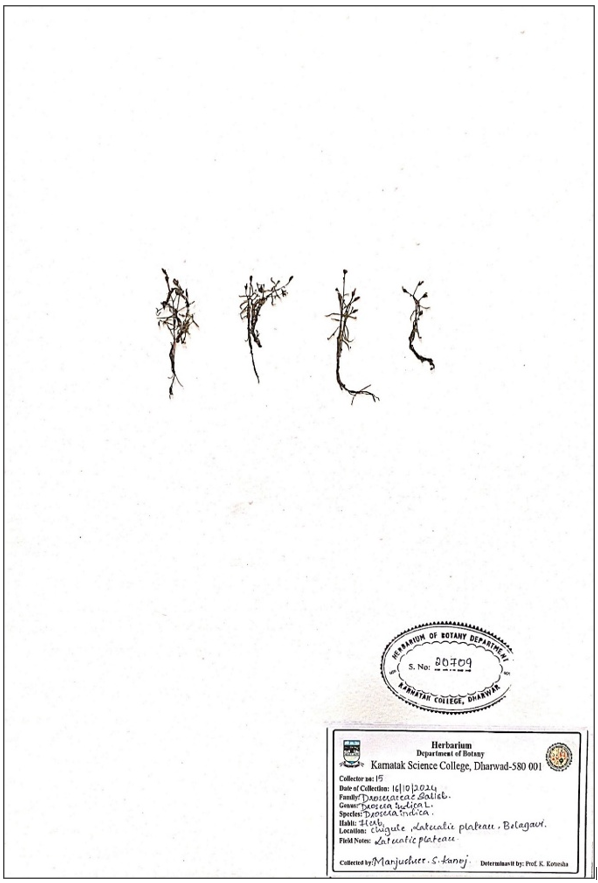
Figure 4: Herbarium of Drosera indica L. submitted to HKSCD
2011; Baskar & Kushalappa, Fl. Tumkur 109. 2014; Bhat, Fl. South Kanara 589. 2014; Nayar et al., Fl. Flowering Plants of Western Ghats 328. 2014 (Figures 3 & 4).
Erect, herbaceous, annual carnivorous plant, 9-25 cm tall. Stem is slender, erect, smooth, usually simple, sometimes shortly branched, green or reddish, with glandular hairs. Leaves are often in a flat basal rosette and cauline, linear 2-6 cm in length, green or reddish, lamina ovate to elliptic or rarely fan-shaped, stalked, glandular trichomes. Inflorescence a raceme, longer than leaves, 8-15 cm long. Flowers are small, delicate, actinomorphic, white, pink or light purple, 1-1.5 cm in diameter. Petals are 5, slightly overlapping, free. Sepals are 5, green, spaced apart. Stamens 5, filaments slender; anthers are yellow or reddish, pollen is small. Superior ovary, 3 fused carpels, trilocular. Style is feathery or unbranched at the tip. 3 stigmas, multiple ovules. Fruit is a small, dehiscent capsule, ovoid or spherical. Seeds are small, ovoid or obovoid, less than 1mm, dark brown in colour, testa shallowly reticulate.
Place of collection: Chikhale, Belagavi; Date of Collection: 16/10/2024; Collector No.: 15; Flowering & fruiting: August-March; IUCN Status: Endangered; Vernacular name: Flycatcher, Shield Sundew, Kriminaashini; Nativity: Bangladesh, Benin, Borneo, Burkina, Combodia, Chad, China, Ethiopia, Gabon, Gambia, Ghana, Hainan, India, Japan, Kenya, Laos, Liberia, Madagascar, Mali, Mozambique, Namibia, Niger, Philippines, Sierra Leone, Sudan, Sumat.
Distribution: Karnataka: Uttarkannada district {Dandeli}, P. A. Hosmani and Dhruva Bhat, 18-4-2025; Hassan district, M. Prashantkumar and N. Shiddamallayya, 23-12-2015; Andhra Pradesh: Visakhapatnam district, K. Jayaram and M.N.V Prasad, 10-9-2006. Kerala: Kannur district, E.P. Suvina, C. Pramod et al., 17-9-2014; Vagamon district K. S. Sudhi, 2-6-2016. Tamil Nadu: Madurai district, K. Natarajan, R. Kottaimuthu et al., 1-12-2008; Telangana: Medak district, Warangal district, Karimnagar district and Khammam district, K. Jayaram and M.N.V. Prasad, 22-6-2006; Chhattisgarh: Gariaband district, Faiz bux, A.M.K. Bharos , M. Suraj, et al., 20-12-2020; Odisha: Puri district, Suvalaxmi Palei, M. J. Dagawal et al.,10-8-2024. Maharashtra: Satara district, S. M. Pawar, S. A. Mohite and S. Sonawane, 13-10-2012.
Drosera peltata Thunb. in Drosera: 7 (1797); Rao & Razi, Fl. Mysore 416. 1981; Yoganarasimhan et al., Fl. Chikamagalur 135. 1981; Saldana, Fl. Karnataka 265. 1996 (Figure 5-6).
Tuberous herb to c. 50 cm high, red to olive-green; stems erect, usually simple, sometimes shortly branched, glabrous; tubers ovoid, up to 6 mm diam., pink to red (on surface), often in a papery sheath; vertical stolon 2-6 cm long. Leaves often in a flat basal rosette and cauline. Basal leaves 4-11; lamina ovate to elliptic or rarely fan-shaped, orbicular or reniform, 1-4 mm long, 2-7 mm wide; petiole linear, 1-12 mm long. Cauline leaves alternate; lamina crescent-shaped with acute angles, 1-4.5 mm long, 1-5 mm wide; petiole 3-19 mm long. Inflorescence a 1-sided raceme, 1-8- flowered; peduncle 1-5(-6) cm long; pedicels 1-10 mm long. Sepals ovate or elliptic, 1.5-6 mm long, 0.1-1.5 mm wide, densely pubescent (c. 5-30 hairs/mm2); margin fimbriate with glandular hairs up to 0.4 mm long. Petals obovate to cuneate, 2.5-5 mm long, 1.5-2.2 mm wide, white. Styles 3, 0.25-1 mm long, divided into c. 15-25 segments. Seeds ovoid or obovoid.
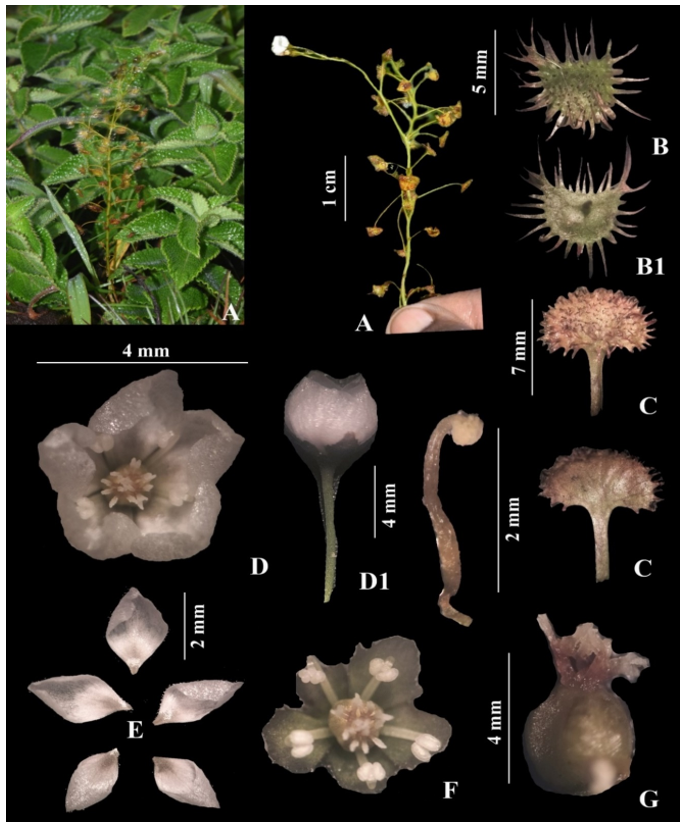
Figure 5: Drosera peltata L. A. Habitat, Inflorescence; B. Ventral surface of trap; B1. Dorsal surface of trap; C. Dorsal and ventral surface of lower basal spathulate-shaped traps; D. Flower front view; D1. Gynoecium; E. Petals; F. Top view of Androecium & Gynoecium; G. Ovary
Place of Collection: Mullyengiri, Devarmane, Chikmaguluru, Tadiyanmol, Kodagu
Date of Collection: 9/09/2025; Collector No.: 30
Flowering & fruiting: September-October
IUCN Status: Least Concern (LC) on the IUCN Red List
Vernacular name: Shield sundew; Nativity: New South Wales, New Zealand North, South Australia, Tasmania, Victoria.
Distribution: Karnataka: Chikkamagaluru district, C. J. Saldanha, K F P 9544, 27-9-1979; Coorg district, C. Sudipta 29-3-2023; Kerala: Palakkad district, C. Sudipta 29-3-2023; Tamil Nadu: Madurai and Nilgiri district, C. Sudipta 29-3-2023.
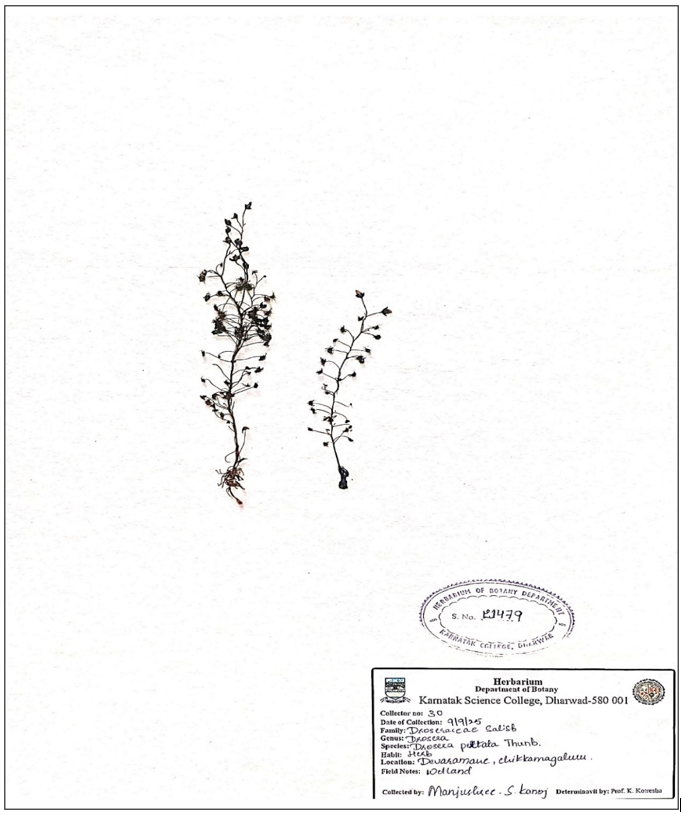
Figure 6: Herbarium of Drosera peltata L. submitted to HKSCD
Pollen morphometry
Table 1: Showing parameters of pollens of Drosera in South India
Scientific name | Shape of pollen | Length | Breadth | L/B | Surface ornamentation | Spines |
D. burmanii | Tetrahedral tetrad | 40.41 µm | 36.91 µm | 1.09 | Tetrad echinate | Numerous, small, uniform spines |
D. indica | Tetrahedral tetrad | 35.76 µm | 28.06 µm | 1.27 | Tetrad echinate | Large spines with globus tip, less numerous |
D. peltata | Tetrahedral tetrad | 33.68 µm | 28.68 µm | 1.17 | Tetrad echinate | Large, flattened spines, few in number |
Key to Drosera based on pollen morphometry:
1. | Spines many, with equal length | D. burmanii |
1. | Spines less, with unequal length, different shapes | 2 |
2. | Spine flattened, less in number | D. peltata |
2. | Spine cylindrical, many in number | D. indica |
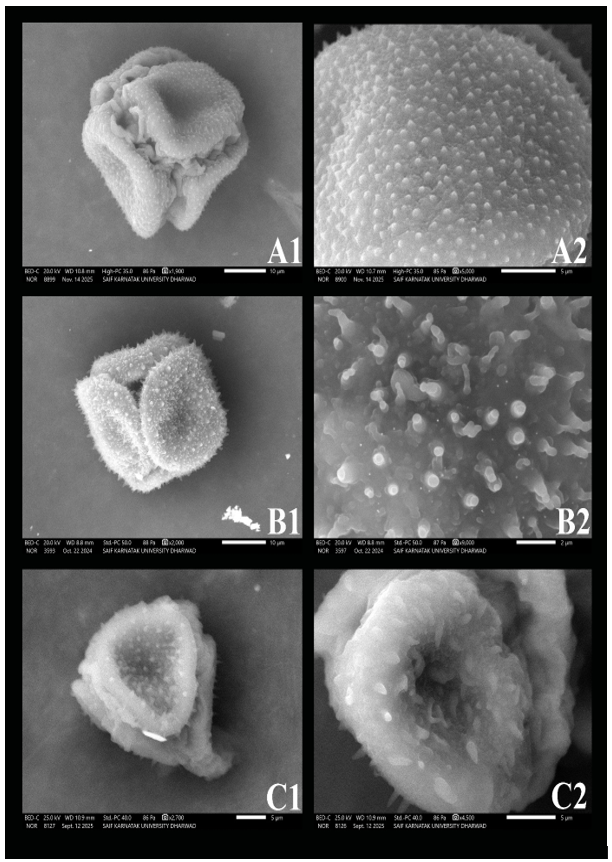
Figure 7: Pollen morphometry of A. D. burmanii; A1. Single pollen; A2. Enlarged surface of pollen; B. D. indica; B1. Single pollen; B2. Enlarged surface of pollen; C. D. peltata; C1. Single pollen; C2. Enlarged surface of pollen
Seed morphometry
Table 2: Showing parameters of seeds of Drosera in South India
Scientific name | Shape of Seed | Length | Breadth | L/B | Shape of testa cell | Wall of testa cell | Length of testa cell | Breadth of testa cell | L/B |
D. burmanii | Prolate to elliptical | 276.8 | 172.9 | 1.60 | Hexagonal to polygonal shape | Thin | 33.71 | 23.64 | 1.42 |
D. indica | Ellipsoidal to ovoid | 430.2 | 289.55 | 1.48 | Polygonal shape | Thick and flat | 53.24 | 33.38 | 1.59 |
D. peltata | Prolate to elliptical | 407.1 | 209.9 | 1.93 | Tetragonal and sometimes pentagonal shape | Thick with large | 43.07 | 35.42 | 1.21 |
Key to Drosera based on seed morphometry
1. | Seeds ellipsoidal to ovoid | D. indica |
1. | Seeds prolate to elliptical | 2 |
2. | Testa cells hexagonal to polygonal; cell wall is thin | D. burmanii |
2. | Testa cells tetragonal to pentagonal; cell wall is thick | D. peltata |
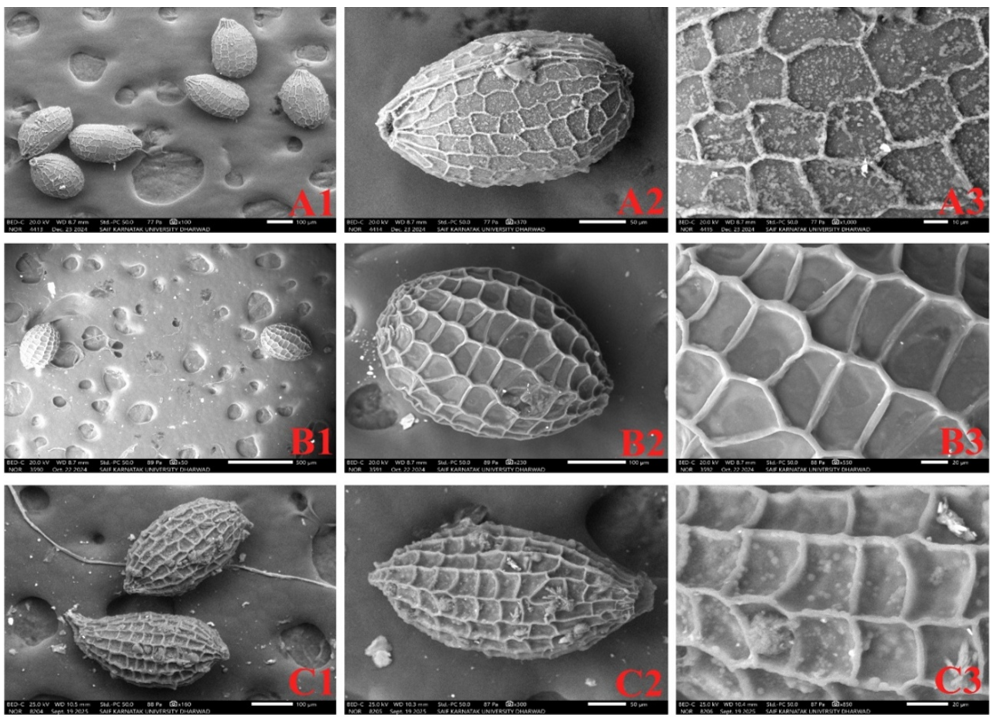
Figure 8: Seed morphometry of D. burmanii A1. Seeds; A2. Single seed enlarged; A3. Seed surface enlarged; B. D. indica B1. Seeds; B2. Single seed enlarged; B3. Seed surface enlarged; C. D. peltata C1. Seeds; C2. Single seed enlarged; C3. Seed surface enlarged
The present study shows that pollen and seed morphological characters provide valuable taxonomic evidence for distinguishing the three Drosera species occurring in South India. All three species possess permanent tetrahedral pollen tetrads with echinate ornamentation, confirming the general palynological features previously reported for the genus by Takahashi and Sohma (1982). However, the present study revealed distinct interspecific variation in pollen size and spine morphology. D. burmannii is characterized by numerous small and nearly uniform spines, D. indica possesses comparatively larger spines with globose apices, whereas D. peltata exhibits fewer, broad and flattened spines. These differences help as characters for species identification. Seed morphology also exhibited considerable variation among the studied species. D. burmannii possesses comparatively smaller prolate-elliptic seeds with thin-walled hexagonal to polygonal testa cells, whereas D. indica has larger ellipsoidal to ovoid seeds with thick polygonal testa cells. D. peltata is distinguished by elongated seeds with tetragonal to pentagonal testa cells and thick testa walls. These observations indicate that seed micromorphological characters are stable within species. The present findings are broadly consistent with earlier reports describing the taxonomic importance of pollen and seed morphology in Drosera. However, previous investigations were largely descriptive or restricted to individual species, whereas the present study provides a comparative evaluation of all three Drosera species occurring in South India using scanning electron microscopy. The integration of quantitative morphometric measurements with qualitative micromorphological observations provides additional evidence for distinguishing morphologically similar species. The identification keys prepared using pollen and seed characters further demonstrate the practical value of these morphological traits for accurate species identification. Such characters may prove particularly useful when reproductive or vegetative morphological characters overlap among closely related taxa. Overall, the present study confirms that pollen and seed morphology constitute reliable taxonomic characters in Drosera. The results contribute additional morphological evidence for species delimitation and provide a useful reference for future systematic, palynological and conservation studies on carnivorous plants of South India.
Acknowledgement
Authors are mainly thankful to USIC DST SAIF SEM Analysis, Karnatak University Dharwad for SEM photographs and measurements. Bottom of Form
References
Bhat, D. & P. A. Hosmani (2025). Distribution and Ecology of Carnivorous medicinal plants Drosera burmannii from kali Tiger Reserve Dandeli of Karnataka, India. Crdeep Journals 14(1): 18-20.
Biswal, D. K., Yanthan, S., Konhar, R., Debnath, M., S. Kumaria & P. Tandon (2017). Phylogeny and biogeography of the carnivorous plant’s family Droseraceae Drosera specie from Northeast India, F1000Research. 6(1): 14-54
Bux, F., Bharose, A. M. K., A. Moiz & M. Suraj, (2021). Record of Drosera burmannii Vahl, a Carnivores Plant from Oddh, Kulhadighat range, Udanti-Sitanadi Tiger Reserve, Chhattisgarh, India. Indian Forester. 147(2):207-208.
Chandler, G. E. & J. W. Anderson (1976). Studies on the nutrition and growth of Drosera species with reference to the carnivorous habit. New phytologist, 76(1): 129-141.
Cross, T. A., Krueger, A., Gonella, M., S. Robinson & S. Fleischmann (2020). Conservation of carnivorous plants in the age of extension. Elsevier. 1(24): e01272.
Darwin, C. R. (1875). ‘Insectivorous plants’ London: John Murray :19-37.
Deshi S., Betageri S., G. V. Patagar & K. Kotresha (2025). Cyperus melanostachyus Kunth. Cyperaceae. a new report to Indian flora. Journal of Diversity Studies 4: 73–77.
Hartmeyer, S. R., Popp inga, S., Masselter, T., I. Hartmeyer & T. Speck, (2013). Trap diversity and evolution in family Droseraceae, Plant signalling & behaviour. 8(7): e24685-5.
Hosmani, P. A. & D. Bhat, (2025). Drosera indica L. Medicinally Important Insectivorous Plant in Kali Tiger Reserve Dandeli of Karnataka, India. Crdeep journals.
Jayaram, K. & M. N.V. Prasad (2006). Drosera indica L. and D. burmanii Vahl., medicinally important insectivorous plants in Andhra Pradesh regional threats and conservation. Current science, 91(7): 943-947.
Juniper, B. E., R. J. Robins, & D. M. Joel (1991). The carnivorous plants, Springer Nature, 46(1): 179-182.
Kottapalli, J. & M. N.V. Prasad (2006). Drosera indica L. and D. burmanii Vahl., medicinally important insectivorous plants in Andhra Pradesh – regional threats and conservation. Current science. 91(7): 943
Koushik, M., B. K. Datta & U. Shankar (2010). Community structure and population status of Drosera burmannii Vahl. with new distributional record in Tripura, India. 3(13):410-414.
Kumar, P. & N. Shiddamallayya (2015). Survey of medicinal plants of Hassan district, Karnataka. Journal of medicinal plant studies. 4(1):91-102.
Lennon, K. A. & T. P. Owen (1999). Structure and development of the pitcher from carnivorous plants Nepenthes alata (Nepenthaceae), American Journal of Botany. 86(10): 1382-1390.
Mithofer, Axel. (2022). Carnivorous plants and their biotic interactions. Journal of plant interactions. 1(17): 333-343.
Natarajan, K., R. Kottaimuthu., V. Balasubramanian., P. Alex Pandian., M. Malaisamy & R. Ponnuchamy (2008). A Note on the Identity of Carnivorous Plants Karungalakudi, Tamil Nadu, India, Ethnobotanical Leaflets: 2008(1): 141.
Pawar, S. M., S. A. Mohite & S. Sonawane (2012). Drosera Burmannii and Drosera Indica -Need of Conservation from Kas Plateau (World’s Natural Heritage Site). International Journal of Pharmacy, Biology and Medical Sciences.1(1):2319-3026.
Praveenkumar, K. (2018). Floristic Diversity of Puliyanamkunnu, Chalavara Grama Panchayath, Palakkad District, Kerala State, International journal of Environment, Agriculture and Biotechnology. 3(6); 2146-2150.
Radhadevi, A. (2003). Forest Management plan of Anshi National Park, Karnnataka, India. Karnataka Forest Department, Dandeli.pp.145
Rao, R. and S. K. Jain (1976). A Handbook of Field and Herbarium Methods. Scholarly Publications. 18-25.
Ravikumar, K. & D. K. Ved, (2000). 100 Red Listed Medicinal Plants of Conservation Concern in Southern India, Foundation for Revitalisation of Local Health Traditions, Bengalore, pp. 1-467.
Sasidharan, N. (2004). Biodi versity documentation for Kerala Part 6 Flowering Plants. Kerala. Forest Research Institute, Peechi, Kerala.
Suvalaxmi, P. D., Mangesh, S., Choudhari, & R. Smita (2024). Ethno Pharmacological values of Drosera indica L.: A Carnivorous plant of India. African Journal of Biological science. 6 (Si4): 2663-2187.
Suvina, E.P., M. Jafer Palot & C. Pramod, (2014). Feeding Ecology of Drosera indica L. on a Midland Lateritic Hill Ecosystem in Northern Kerala, South India.
Tagawa, K., Sando, T., M. Aoki & M. Watanabe (2024). Comparison of prey fauna in tropical red traps versus temperate whitish traps in carnivorous Drosera indica complex (Droseraceae). Plants species biology. 39(3): 173-180. htttps://doi.org/10.1111/1442-1984.12451
Takahashi, H. & K. Sohma (1982). Pollen of the Droseraceae and its related taxa, Sci. Rep. Tohoku Univ. 4(38): 1-1.

Dedicated to advancing biodiversity conservation and the sustainable management of natural resources for current and future generations.
Copyright © 2026 Journal of Biodiversity And Conservation || Designed By Antler’s Solution